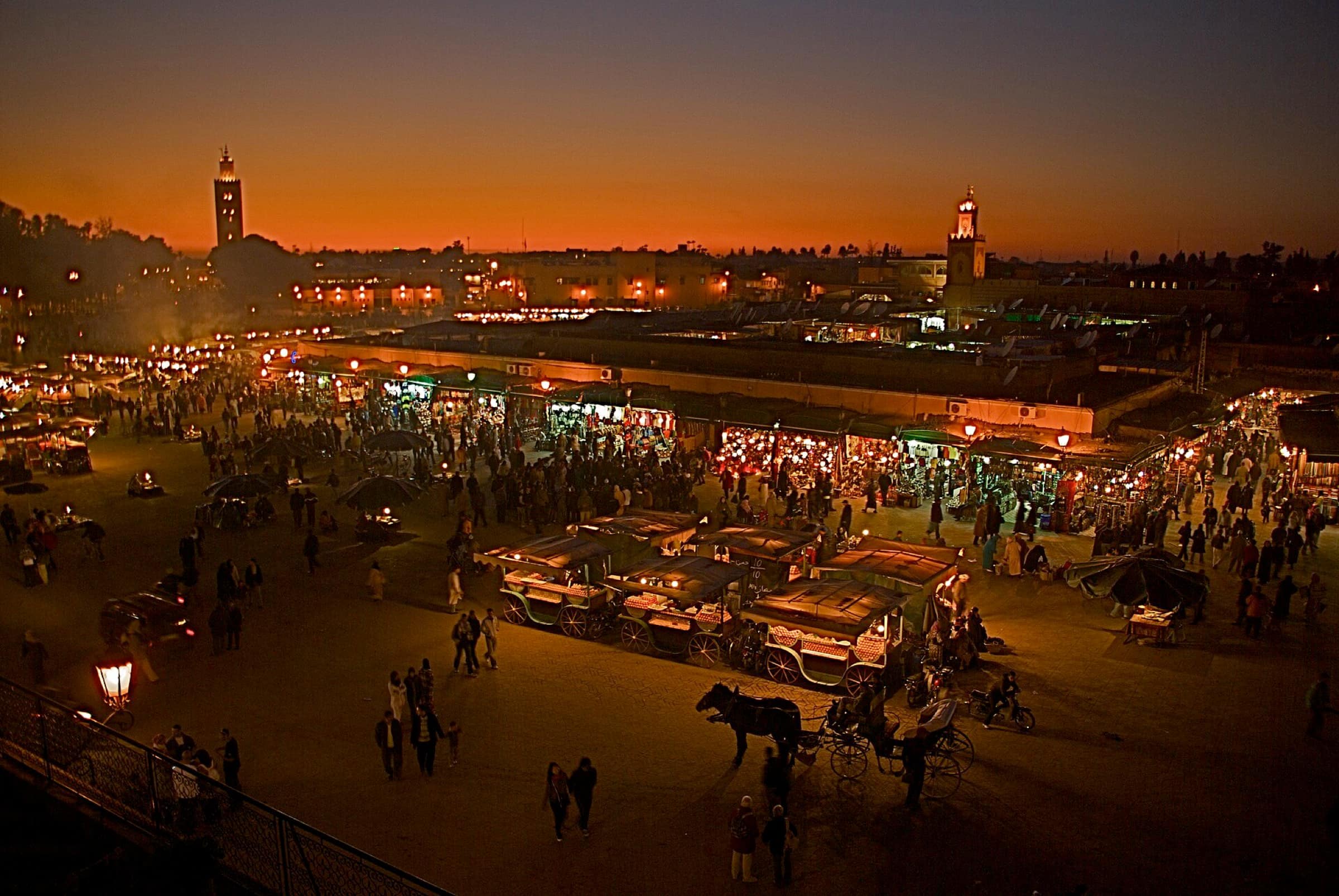
Animal ethics on Jemaa el-Fna, what I gave up doing (and what I do instead)
Practical tips
A baby macaque tugged at the end of a chain, a cobra that barely moves, a calèche at a standstill under 42°C. These three scenes on Jemaa el-Fna, I photographed them, paid for them, funded them. Then I read the studies, I crossed paths with SPANA vets, I looked at the UNESCO listing for the square. I stopped.
That evening, a handler in his thirties offered me his baby macaque for 100 dirhams a photo. The animal, in a child’s nappy, held by the collar, gripped my forearm with the panicked strength of a newborn. It must have been three to four months old. Its mother was dead, or lived somewhere in the cedar forests of the Middle Atlas, four hours away by road. I did not take the photo. I paid all the same, and I walked away. Since then, I have read the studies that describe what I had just held in my arms.
Three practices I no longer take part in
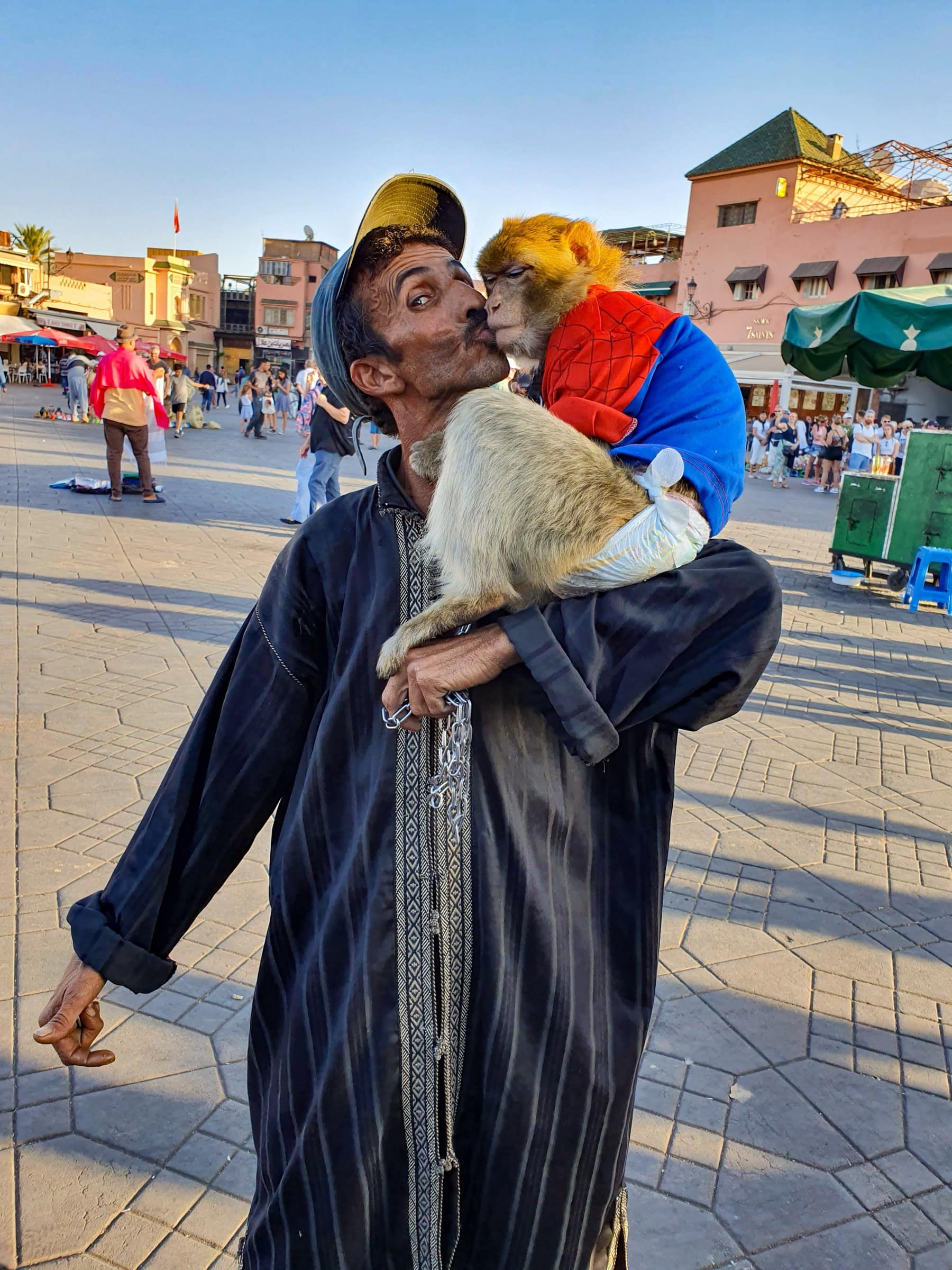
A photo with a macaque. The Barbary macaque (Macaca sylvanus) is the only primate species in North Africa. It has been classed as Endangered by the International Union for Conservation of Nature since 2008, a status confirmed by the Wallis et al. reassessment of 2020. The global wild population, Morocco and Algeria combined, is estimated at 5,000 to 10,000 individuals against more than 20,000 in the early 1980s. The decline runs beyond 50% over three generations. Since CoP17 in Johannesburg in September 2016, in force from early 2017, the species has been included in CITES appendix I, the highest level of protection: international trade banned. Morocco, a signatory since 1975, applies law 29-05 of 2011 for possession and control, with fines from 5,000 to 30,000 dirhams (£400 to £2,400) and administrative confiscation under the authority of the Agence Nationale des Eaux et Forêts.
On Jemaa el-Fna, a Born Free Foundation field report of 2019 (picked up by a National Geographic investigation in 2019, updated in 2023) counts 17 people holding a waiver permit to exhibit a macaque as a photo prop. Historical regime, contested by NGOs, tolerated under the cultural heritage label. The young ones used are taken from their mothers at 3-6 months, in the cedar forests of Ifrane and Azrou. Trafficking to Europe, documented by IFAW from 2015 on, represents 200 to 300 infants a year, where a juvenile reaches £1,700 (€2,000) on the underground pet-shop circuit. The Barbary macaque is today the most-seized CITES mammal in the European Union, around a quarter of all live-mammal seizures.
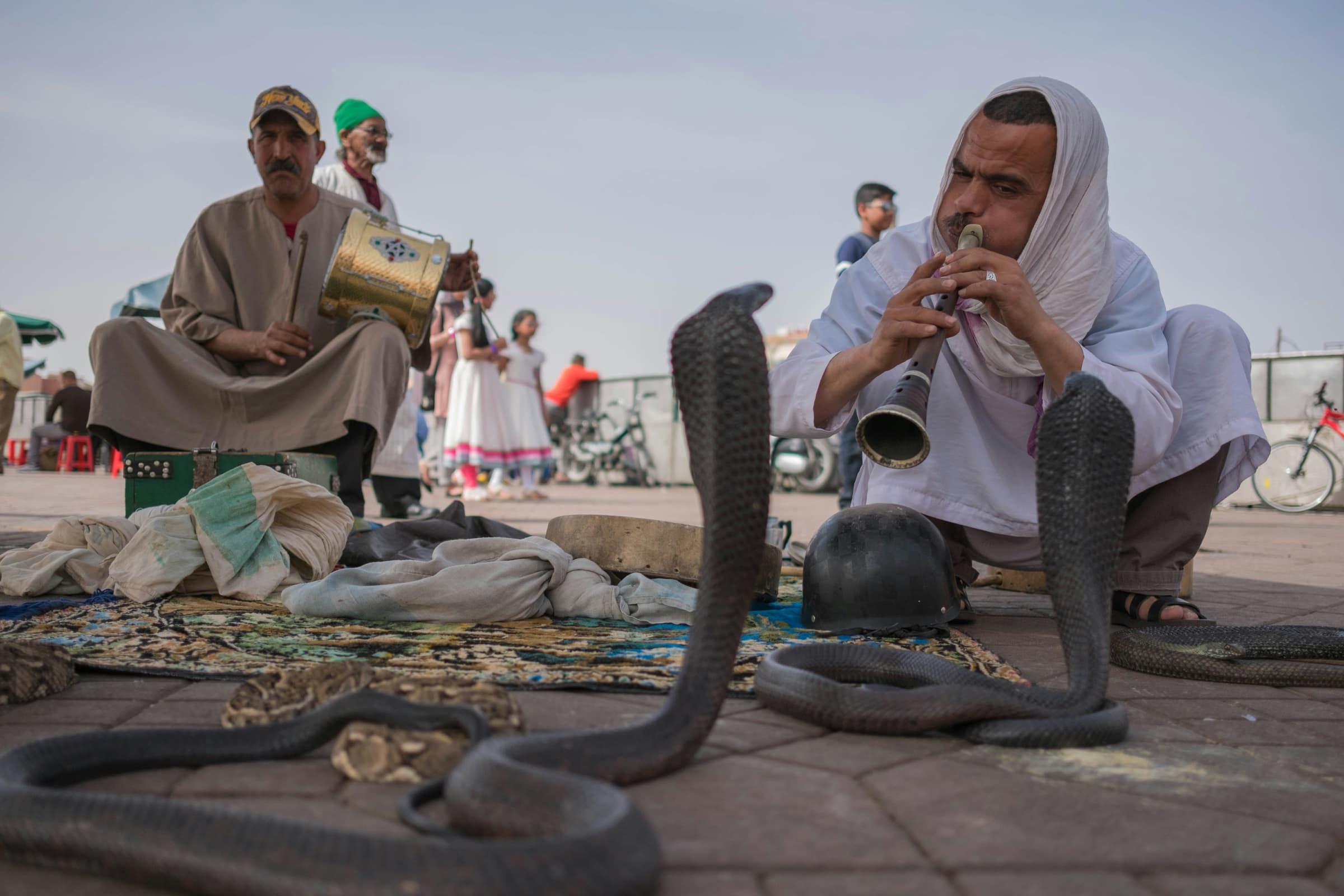
Watching a cobra charmer. A benchmark study by Pleguezuelos, Feriche, Brito and Fahd published in Oryx (Cambridge, 2017) documents 8 species exploited on Moroccan squares, against more than 15 twenty-five years ago, a sign of thinning stocks. The main ones are the Egyptian cobra (Naja haje), the puff adder (Bitis arietans), the horned viper (Cerastes cerastes) and the Moorish viper (Daboia mauritanica), on its own responsible for close to 70% of the serious bites reported annually in Morocco. The study lists 86 charmers active between 2003 and 2014, around 70 of them (81%) permanent on Marrakech. Yearly capture, all species combined, is estimated at 4,500 snakes.
The preparation technique is described precisely by several academic investigations and by The Conversation in June 2023: fangs pulled with pliers, venom glands pierced or stitched, mouth sometimes stitched shut leaving only a slit for the tongue. The snake is no longer dangerous, but dies of sepsis, infection or starvation within a few weeks to a few months. Life expectancy of a cobra in the wild: 10 to 20 years. Life expectancy of a captive mutilated cobra on Jemaa el-Fna: a few months.
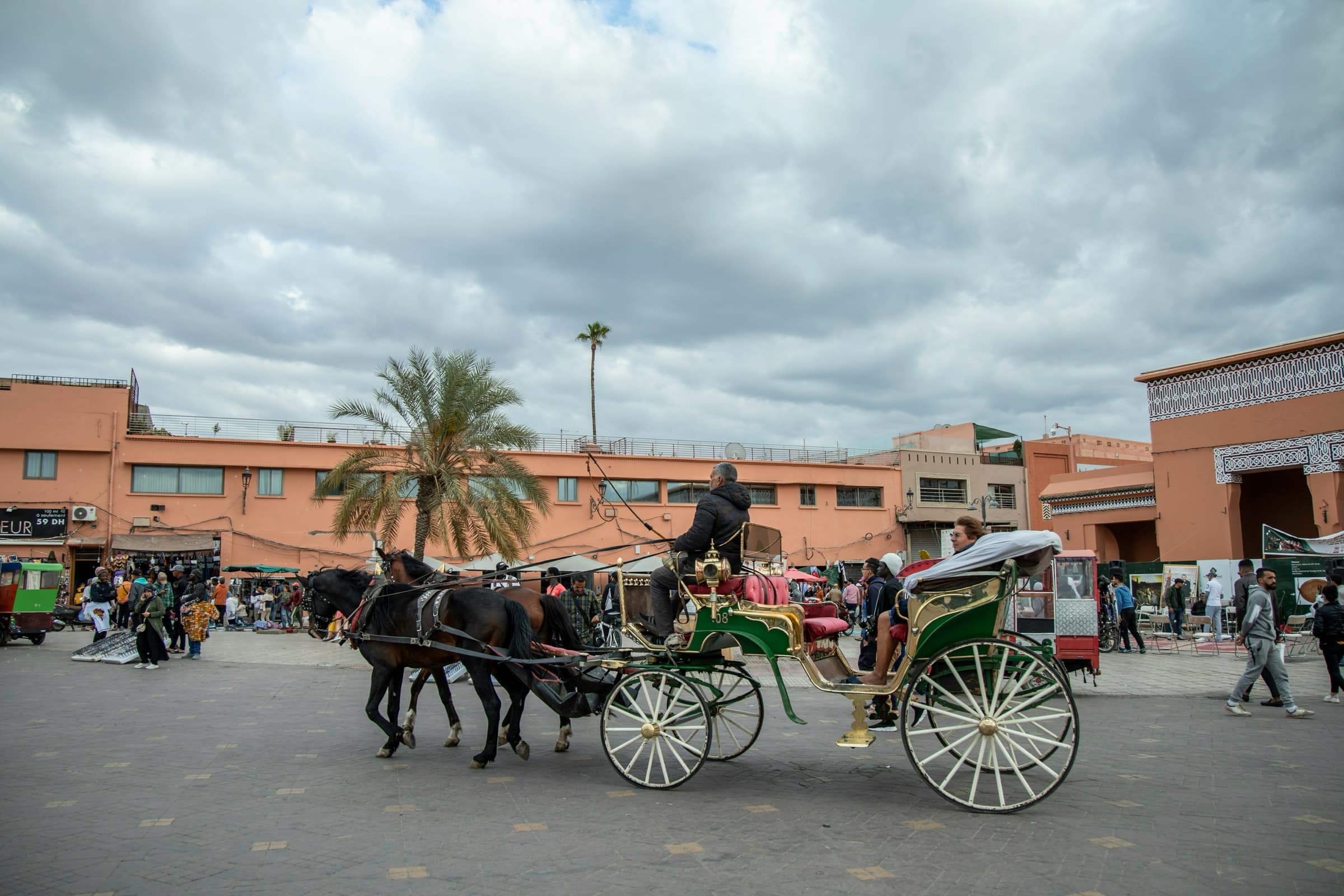
A calèche at a standstill under 42°C. The file is more nuanced, because a framework exists. Marrakech has 148 calèches in circulation, under a municipal decree going back to 1935. Since 2019, the drivers have worn an ochre uniform. The horses are hoof-marked by branding, foreleg-marked by SPANA bracelet and neck-marked by subcutaneous chip. The SPANA clinic in Cité Mohammadi in Hay Mohammadi, rue Ibn Sina, the NGO’s largest facility in Morocco, follows around 300 horses, issues licences and refuses to put a horse to work after two consecutive tickets for poor condition. Three technical inspections a year, around ten waterholes on the ranks, a rescue cart (“Guerab Lkoutchi”) on the go. Since 2023, a partnership with the TUI Care Foundation funds the audit and treatment of more than 500 working animals linked to tourism.
The programme has been recognised with the sustainable tourism trophy from the Moroccan Ministry of Tourism. It is one of the rare set-ups in Morocco at this level of rigour. And yet, a draught horse, even well followed, struggles at 42°C. I do not take a calèche between June and September. The rest of the year, I climb aboard if the animal is in flesh, no rib showing, no wound under the girth, no visible limp. Otherwise, I skip it.
The legal frame, real and fragile
Three texts sit on top of each other, and one gap.
On the wildlife side, law 29-05 of 2011 (dahir 1-11-84) on the protection and trade of wild species has had its implementing decree since 2015. ANEF, formerly the High Commission for Water and Forests, is its management and policing authority. Morocco has been a CITES signatory since 1975. Fines run from five thousand to thirty thousand dirhams depending on the species and its status, with administrative confiscation. It is the legal base on which reptile and mammal seizures in Marrakech rest.
On the animal side in general, the Moroccan Penal Code of 1962 (dahir 1-59-413) provides, at articles 601 to 603, for penalties for poisoning a draught animal, mutilation without necessity, ill-treatment. Article 601 punishes with 1 to 5 years of prison and 120 to 500 dirhams (£10 to £40) of fine. Article 602: 2 to 6 months of prison and 120 to 250 dirhams (£10 to £20). These texts are old, the penalties weak, enforcement rare and not publicly quantified.
The gap is the sentient animal. Moroccan civil code does not recognise the animal as a sentient being, which is precisely the headline demand of the counter-bill tabled in Parliament by the SPA du Maroc in 2024-2025. In July 2025, the government adopted in Council of Government a draft law 19.25 on stray animals, forwarded to the House of Representatives and to the Productive Sectors Committee. This text, presented as a step forward in the context of AFCON 2025 and the 2030 World Cup, is contested by the SPA du Maroc and by Network for Animals. Its article 5 criminalises feeding or sheltering a stray animal outside an approved centre (1,500 to 3,000 dirhams, £120 to £240, of fine). Its article 36 punishes with 2 to 6 months of prison the torture of a stray animal. For the SPA du Maroc and Network for Animals, this is a sorting law, not a protection law. Not enacted to date.
What UNESCO really protects
The argument is often served up: Jemaa el-Fna is UNESCO-listed, everything that happens there is part of the heritage. That is not what the listing says.
The square was proclaimed “masterpiece of the oral and intangible heritage of humanity” in May 2001, the very first inscription of this kind in the world, pushed by Spanish writer Juan Goytisolo against a glass tower project that threatened the medina. In 2008, it was added to the Representative List of the Intangible Cultural Heritage, under file number 00014.
The official listing names precisely what is protected: storytellers (the hlaykia), poets, Berber musicians (mazighen), dancers and senthir/hajouj players from the gnawa brotherhood, acrobats and snake charmers. It does not mention macaque handlers. Nor the fantasia. Nor the calèches. The listing protects a cultural space and a spoken, sung, played human performance. It says nothing about animals and holds no animal welfare clause.
Put plainly: when a macaque handler invokes the heritage, they invoke a listing that does not cover them. When a cobra charmer invokes it, they are indeed mentioned, but neither the CITES frame nor law 29-05 shift for that reason. An oral practice can be heritage and hurtful to the animal it uses.
What I do instead
Six alternatives, plus one method.
| What I skip | Alternative | Where | Detail |
|---|---|---|---|
| Photo with a macaque | See wild macaques | Cedar forests of Azrou and Ifrane | From a distance, no feeding |
| Cobra charmer | Listen to a hlaykia (storyteller) | Café Clock, Kasbah quarter | Thursday 7pm, stories in darija and English, free entry |
| Cobra charmer | Live gnawa group | Gnaoua Festival, Essaouira | June, forty maâlems, three hundred and fifty artists |
| Summer calèche | Donkey and mule refuge | Jarjeer Refuge, Oumnass (24 km south) | Visit by prior appointment |
| Summer calèche | Equine clinic | SPANA Cité Mohammadi (Hay Mohammadi) | Guided tours on request |
| Tourist fantasia | Human circus school | Groupe Acrobatique de Tanger, Shems’y school in Salé | Tours, shows to book ahead |
On the square, in the evening. The hlaykia are only a handful today, all over fifty. They run their halqa on the north-east side. In darija. Understanding them is not essential to drop a dirham in the cap at the end of the story, the gesture keeps a dying tradition alive. The regular programming of Café Clock in the Kasbah, on Thursday at 7pm, offers storytelling evenings translated into English by apprentices trained by the late Hajj Ahmed Ezzarghani. Free entry.
For the music. The gnawa musicians play every evening on the square, no animal intermediary. The Gnaoua Festival in Essaouira is their big yearly window: its 26th edition, from 19 to 21 June 2025, brought together 350 artists including 40 maâlems, across 54 concerts and 4 stages. The 2026 edition is announced from 25 to 27 June. Two and a half hours by road from Marrakech, a good reason to leave town.
For acrobatics. The Groupe Acrobatique de Tanger, founded in 2003 by Sanae El Kamouni, is the direct heir of the Ouled Sidi Ahmed ou Moussa, the acrobat brotherhood from the Souss going back to the 16th century. Its shows Halka, FIQ! and Azimut tour the world. In Salé, the École Nationale de Cirque Shems’y has been training artists from working-class backgrounds since the early 2000s, with a high employment outcome.
For wild macaques. The cedar forests of Azrou and Ifrane in the Middle Atlas, 3-4 hours by road from Marrakech, hold a semi-habituated population that lets you watch it from the edge of the forest tracks. The rule: distance, silence, no food. The groups live their lives, I watch from fifteen metres. The Ifrane National Park, 125,000 hectares, protects the largest cedar forest in the world. That is where conservation plays out, not on a tourist square.
For horses, donkeys and mules. The Jarjeer Refuge, in the village of Oumnass 24 km south of Marrakech, in the foothills of the High Atlas, has welcomed retired working equines since 2014. Founded by Susan and Charles, two British lawyers settled in Morocco, it holds around thirty residents and employs 14 people. Open 24/7 in an emergency, it accepts visits by prior phone appointment. The visit is a moment of meeting, not a zoo. The SPANA clinic in Cité Mohammadi also runs guided tours on request.
On the ground, what I actually do
To take it further
- To plan a day on the square without falling into the traps: our Jemaa el-Fna listing.
- For the ethics of street photography, of which animal photography is part: Photographing Marrakech, field notes.
- For the same questions at child height, with the right visitable alternatives: Marrakech with family.
- To choose an ethical horse ride in the Palmeraie: our activity listing.