Alcohol in Marrakech, the honest picture: where I buy, where I drink, what I do not do
Practical tips
Marrakech is not a dry town, nor a town where alcohol flows freely. It lives between the two, with a legal frame that dates back to 1967, palaces that serve, supermarket aisles that shut for the whole of Ramadan and a tax that jumped 76% on wine in 2025. Here is what I finally figured out.
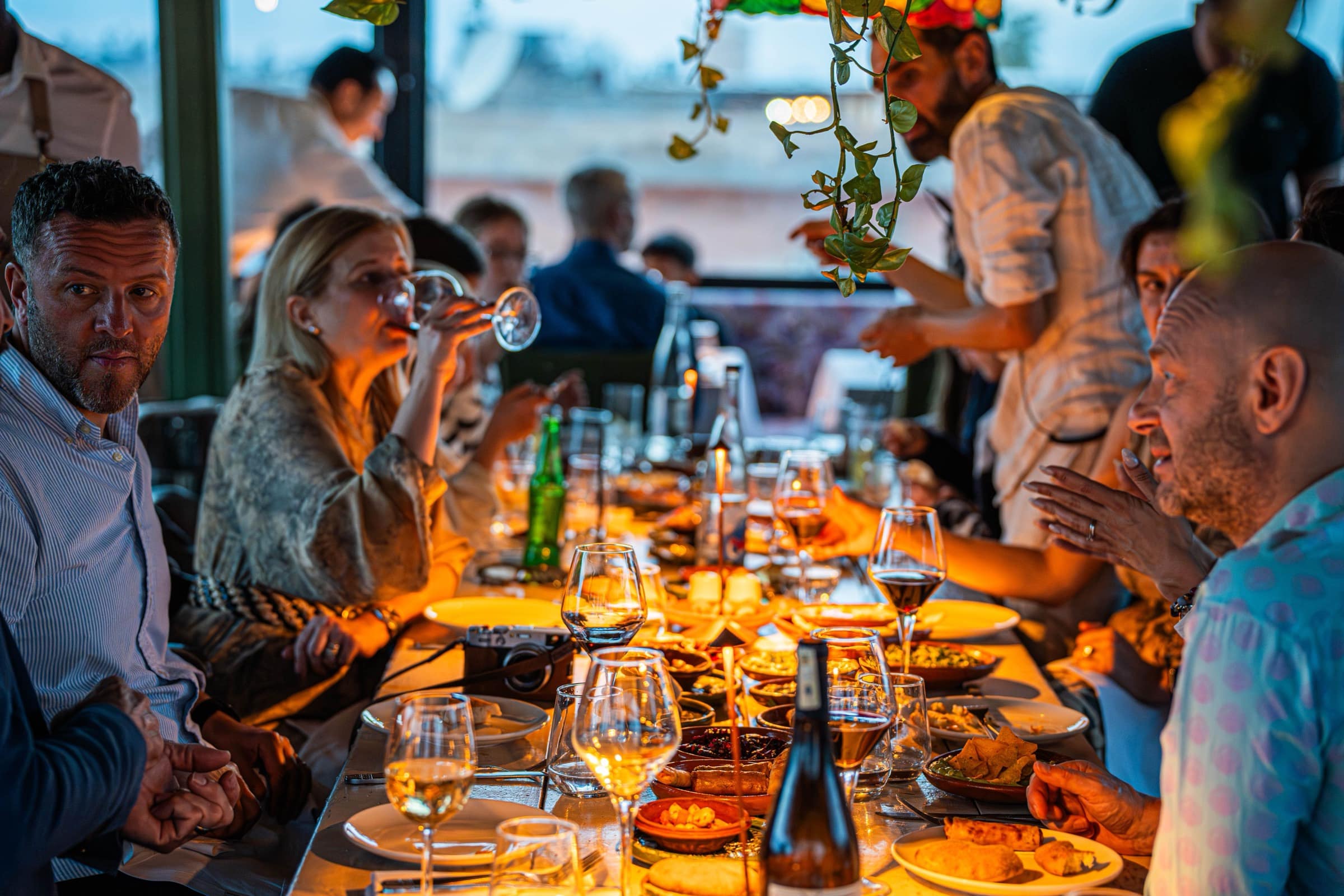
A Friday evening in Guéliz, glass of Moroccan red at the Baromètre. On my right, a French couple just off the plane. On my left, a Marrakchi living in Paris, back for the weekend. Opposite, a local man in his fifties ordering the same as me. The town is not dry. Nor is it a cocktail postcard. It runs at its own pace, with a legal frame going back to 1967, taxes that just jumped and a hundred or so addresses where I can genuinely sit down and have a drink.
What the legal frame really says
There is no “law 26-19 on alcohol” in Morocco. Nor is there any “code of drink licences” in the French sense. The founding text is the decree of the director general of the royal cabinet n° 3-177-66 of 17 July 1967, layered with annual fiscal decrees and with Wilaya administrative policing. That is the lawyer’s version. On the traveller’s side, what counts: selling to a Muslim Moroccan is banned on paper, with penalties reaching up to a few months of prison and 300 to 1,500 dirhams of fine. At the daily till, it is very marginally enforced. Reminders come in waves, often political.
“Licence IV” is a French expression with no legal equivalent in Morocco. A bar or restaurant pours under a hotel licence (attached to a classified hotel, palaces included), a restaurant licence (high-end dining with table service) or a 2nd-category drink licence (bars). The Marrakech-Safi Wilaya issues them. In practice, seven medina rooftops pour under their hotel licence, every palace and 4-5* hotel pours, around thirty restaurants have taken a restaurant licence.
What shifted in late 2025. The 2025 Finance Bill raised domestic consumption tax: +76% on wine (from 850 to 1,500 dirhams per hectolitre) and +74% on beer (from 1,150 to 2,000 dirhams per hectolitre). Treasury target: 3.5 billion dirhams of alcohol revenue in 2026. In practice, a local draught beer runs 40 to 80 dirhams (£3.20 to £6.40) depending on the venue, an imported beer 60 to 100 (£4.80 to £8), a glass of local wine 60 to 120 (£4.80 to £9.60), a glass of imported wine 80 to 150 (£6.40 to £12). National consumption keeps rising all the same: 103 million litres of beer and 12.7 million bottles of wine a year per figures published by the Ministry of Finance.
Where I buy my wine
Two channels, which I never mix.
Nicolas Marrakech, set up since December 2005, is my wine merchant of choice. Two shops: one in Hivernage in the Résidence Bouroud, avenue Mohammed VI, the other in Guéliz avenue Mohammed V. Open Monday to Saturday, 10am to 1pm and 3pm to 7pm. The list holds up both on the French side (bordeaux, burgundies, champagnes, crémants) and the Moroccan premium side (high-end Château Roslane, Volubilia, Val d’Argan). This is where I buy when I want a precise wine, a food-wine pairing or a gift to bring home.
Carrefour Al Mazar on Mohammed VI avenue, next to Menara Mall, holds a dedicated-till alcohol aisle. Bottom-shelf prices, limited choice but enough for a riad dinner. Careful: the aisle shuts before the shop, often around 8pm in the evening. Atacadao on the Casablanca road runs the same setup, a bit further from the centre. Marjane stopped selling alcohol in 2012, a board decision rolled out chain-wide: old blogs still listing it have not been updated.
Foreign wine has a cost. Between TIC, VAT and margins, an entry-level bordeaux lands in Morocco 40 to 50% pricier than in Paris before shop margin. I buy French when I have a precise pairing in mind, Moroccan the rest of the time.
What gets poured
Beers. They are all made by the Société des Boissons du Maroc (SBM, formerly Brasseries du Maroc), founded in 1919, 69.3% controlled by the French Castel Group, head office in Casablanca. Three brands dominate:
- Casablanca: premium blonde lager, around 5°, the most visible in tourist bars, white label, green bottle.
- Flag Spéciale: mainstream pilsner, the best-selling beer in Morocco, the one you find in every supermarket.
- Stork: light lager, recently rebranded (red and yellow) to target the urban young.
One current event that matters. The historical SBM-Heineken partnership, running for forty years, ended in early 2026. SBM turned to Carlsberg and put out its own premium, Flag Spéciale Gold. Put plainly: the Heineken on tap you used to find everywhere is no longer the automatic standard. On the cards, it is replaced by imported Carlsberg or by the local Gold. I was caught out the first time.
Moroccan wine. Four appellations d’origine garantie (Guerrouane, Beni M’Tir, Zaër, Berkane) and one appellation d’origine contrôlée (Coteaux de l’Atlas). The landscape:
- Château Roslane / Celliers de Meknès (Zniber group, founded in 1964) leads with around 85% of national output, 2,000 hectares in AOG Guerrouane and Beni M’Tir. Its range covers everything, from table wine to top of the line (Château Roslane Premier Cru).
- Domaine Ouled Thaleb in Benslimane, the oldest still-active estate in the Maghreb, puts out age-worthy reds often underrated.
- Domaine de la Zouina signs the Volubilia range in red, white, gris.
- Val d’Argan in Essaouira, 23 km inland, is the southernmost vineyard in Morocco. The project of Rhône winemaker Charles Mélia, southern varieties (Syrah, Grenache, Cinsault).
The leading varieties: Cinsault, Grenache, Carignan, Syrah for reds, Chardonnay and Sauvignon for whites. And the true Moroccan signature: the gris, a very pale sec rosé, to drink young and cold. It sees off a tagine dinner on its own.
A word on mahia. It is the traditional spirit of Morocco’s Jews, distilled from dried figs or fermented dates, sometimes flavoured with anise or fennel, at 40 to 50 degrees. Historically made in the mellahs of Fez, Marrakech and Essaouira, it has almost vanished commercially in Morocco today. Jewish emigration in the 1950s and 60s exported the tradition to Israel and France. In Marrakech, one or two restaurateurs bring it out on request. I order it at the end of a meal when I land on the right one.
Where I go to drink
| Type | Address | Where | Detail |
|---|---|---|---|
| Cocktail bar | Baromètre | Guéliz, rue Moulay Ali | Cocktails with souk herbs (verbena, saffron, cardamom) |
| Rooftop wine bar | Nomad | Medina, Rahba Kedima square | Moroccan wine, cocktails, modern cuisine |
| Medina rooftop | Kabana | Medina, 7 floors | Atlas view, licence via adjacent riad-hotel |
| Sky bar | Le Salama | Edge of Jemaa el-Fna | 3 levels, cocktails + wine + beer |
| Dinner-cabaret | Comptoir Darna | Hivernage, av. Echouhada | Since the late 1990s, £48-£72 pp with drinks |
| Palace bar | La Mamounia - Churchill Bar | Hivernage | Refit by Patrick Jouin, black marble counter |
| Palace bar | Royal Mansour - The Main Bar | Medina | Sculpted silver ceiling, roaring twenties style |
| Palace bar | Selman - Le Bar Selman | Amizmiz road | Jacques Garcia design, cocktails-cigars |
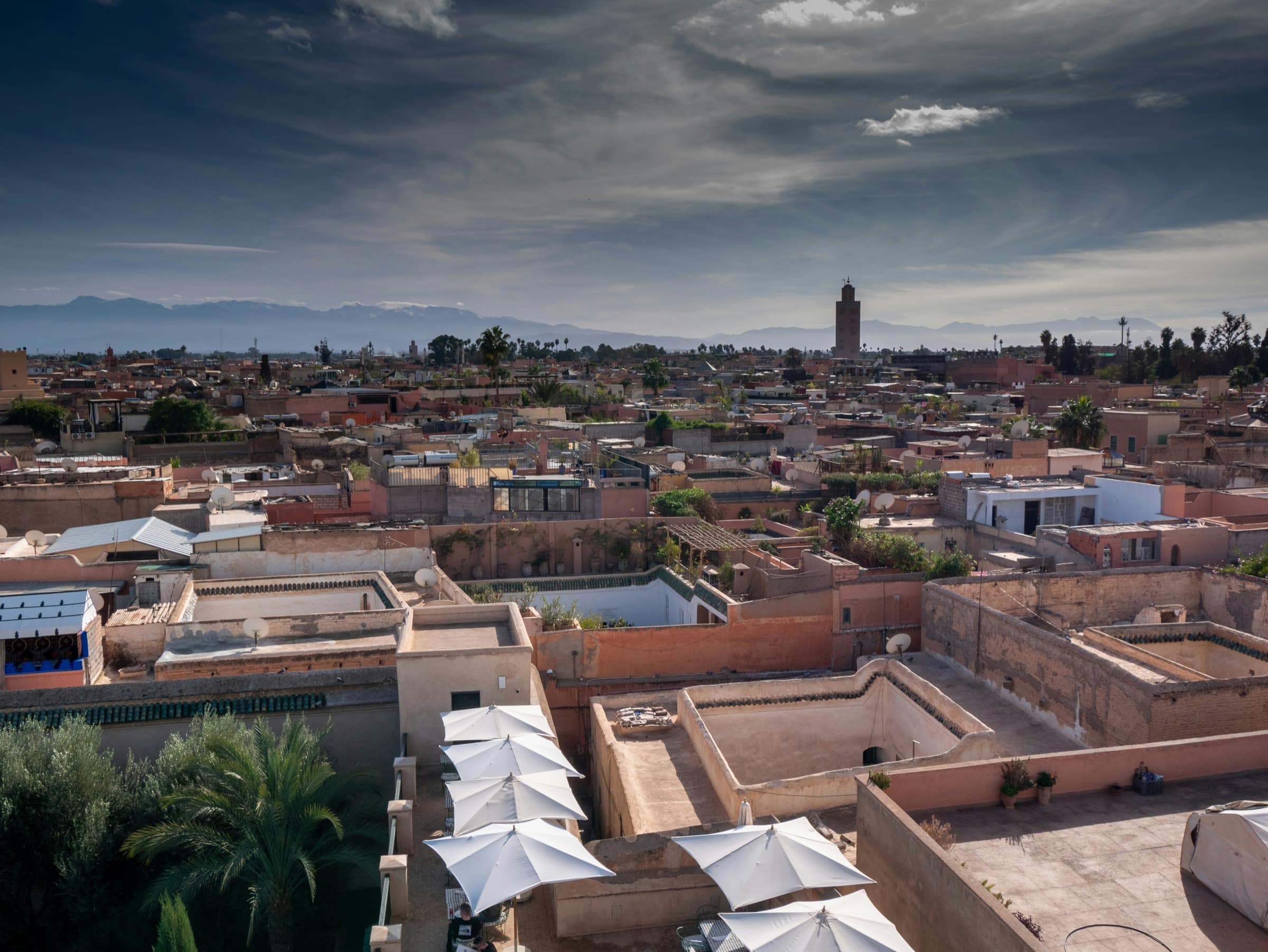
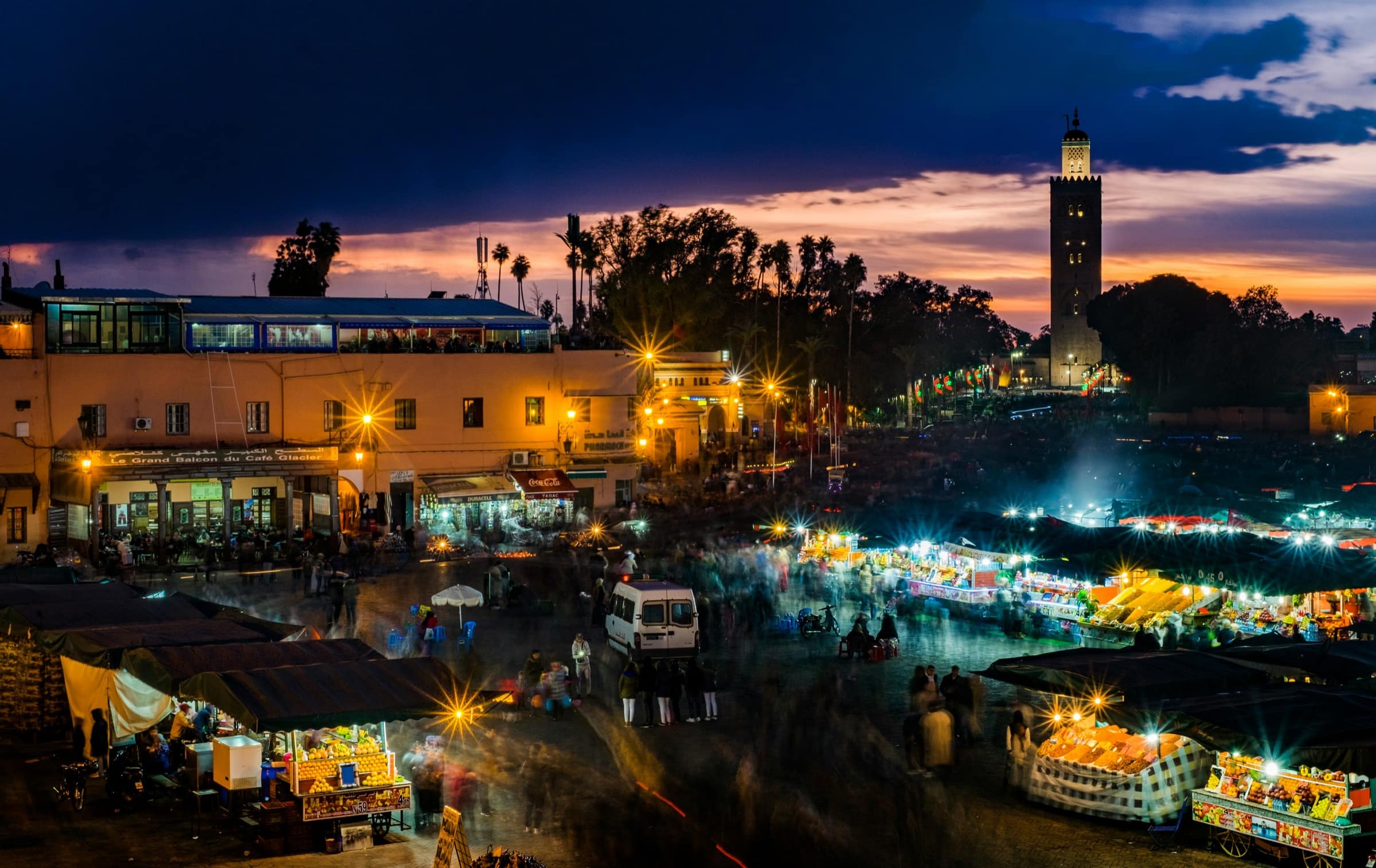
Medina: seven licensed rooftops, the rest dry. Café Arabe, El Fenn, Le Foundouk, Kabana, DarDar, Le Trou au Mur within La Farnatchi and Terrasse des Épices - these seven pour alcohol in 2026. The other rooftops (Nomad outside the ground terrace, L’mida, Café des Épices) stay on mocktails, tea, juice. The glass at El Fenn or Kabana: 150 to 190 dirhams (£12 to £15) for a cocktail with Koutoubia view at dusk.
Guéliz and Hivernage: the real density. This is where I go when I want a bar in the European sense. Baromètre on rue Moulay Ali (Guéliz) is the cocktails reference: signatures with souk herbs, Moroccan raw ingredients, glasses in the £24 range. +61 on Australian cuisine, Kilim and Chameleon on restaurant + bar. On the Hivernage side, Comptoir Darna is a dinner-cabaret set up since the late 1990s, more than 14,000 Google reviews, “meal + show + drinks” format between 600 and 900 dirhams (£48 to £72) per person. Le Salama overlooks Jemaa el-Fna on three levels with sky bar and cocktail list.
Palaces: three landmarks. La Mamounia’s Churchill Bar was refitted by Patrick Jouin in 2020, black marble counter, Pullman-cigar mood, historical reference in town since Winston Churchill’s own nights. The Main Bar at Royal Mansour plays a more opulent visual card: sculpted silver ceiling, roaring twenties spirit, service in armchairs. Le Bar Selman at Selman Marrakech, on the Amizmiz road, carries the Jacques Garcia signature, cocktails-cigars format in a closed lounge. All three cost (150 to 250 dirhams the coupe, 200 to 400 the signature cocktail, £12 to £32) and are earned: dress code in play, booking useful late in the day.
What changes during Ramadan
Ramadan runs each year over a roughly four-week window, sliding by about eleven days earlier in the Gregorian calendar. Across 2025-2030, that puts it in February-March, with dates confirmed the evening before by the Ministry of Habous and Islamic Affairs after moon sighting, to within a day. The precise dates for the next month sit in the FAQ at the foot of this page.
What actually shifts:
- Supermarket alcohol aisles: fully shut from the first to the last day of the month. Including for non-Muslim tourists. Carrefour Al Mazar, Atacadao: shutter down on the aisle. This is the point that catches many travellers out. You have to buy ahead.
- Nicolas Marrakech closes for Ramadan, as it has for the previous five years. Put plainly, once the month starts, no restocking in town: what is in the riad stays in the riad.
- Palace bars and restaurants under hotel licence: pour normally indoors, to their seated clientele. The Churchill at La Mamounia, the Main Bar at Royal Mansour, Le Bar Selman all run. Musical programming eased, less dancing mood, but the glass keeps coming.
- Medina restaurants with a restaurant licence: case by case. Some cut the by-the-glass service on open-air terraces, keep wine only for guests seated inside. Others suspend fully for the month.
- Guéliz and Hivernage cocktail bars: open, eased. Musical programming quieter, service to midnight max instead of 2am, no loud party.
Eid al-Fitr, closing the month: bars and drink venues shut for at least twenty-four hours, often forty-eight. Progressive resumption over the two days that follow. Ashura and Mawlid, shorter, close some venues occasionally with no uniform instruction.
One practical note: during Ramadan, the town lives out of phase. Ftour is taken at sundown, sohour early in the morning, the souks run to three in the morning. It is one of the best moods of the year in Marrakech, and alcohol here is neither the question nor the problem.
On the ground, what I actually do
To take it further
- For the sober mirror view, which addresses to skip and how to read Ramadan on the non-Muslim side: Halal travel in Marrakech.
- For the full medina rooftops map, licensed or dry: our rooftops guide.
- For the two bar neighbourhoods, mood and addresses: Hivernage and Guéliz.
- For dinner-shows Chez Ali, Comptoir Darna and Fantasia, “drinks included or not” format: our activity listing.
- For the fine-dining tables with a serious cellar: our fine dining guide.