Halal travel in Marrakech: what you do not have to check, and the few points to frame, 2026
In Marrakech, restaurant halal compliance, the presence of mosques, qibla orientation in riad rooms and Qur'an availability are the rule, not the exception. A Muslim traveller does not need a specialist agency to come. This guide says what is already in place, what still needs framing and how to live Ramadan on site.
Morocco is a mostly Muslim country. Restaurant halal compliance, the presence of mosques, qibla orientation in riad rooms and Qur’an availability on request are the rule, not the exception. A Muslim traveller does not need a specialist agency to come to Marrakech, or a ‘muslim-friendly’ labelled contract to find where to eat, pray and sleep in line with their practice. This guide says what is already in place, what still needs framing (international palace bar, mixed hammam, Ramadan period on the non-Muslim traveller side) and points to the site sheets for the concrete planning.
What halal travel really means
A stay compatible with the precepts of Islam rests on a few simple guarantees: halal food, no alcohol served or visible at the table, modest environment, access to prayers. That is the heart of it. Alongside sits a distinct marketing category, ‘muslim-friendly’ travel, structured by indexes (Global Muslim Travel Index published by Mastercard-CrescentRating, HalalTrip), labels and specialist agencies. This category makes sense in certain contexts (supervised group trip, destinations where halal is not the local norm), less in Marrakech where compliance is the cultural default.
In Marrakech, the practising traveller’s question comes down to two things: ‘which hotel or riad matches my ways?’ and ‘how do I live Ramadan if I am here during it?’.
Marrakech by default: what is already in place
Food. Nearly every Moroccan restaurant serves halal, no explicit mention on the card, because that is the cultural norm. That holds for riad tables, Jemaa el-Fna street stalls, Moroccan-French restaurants in Guéliz and fine-dining tables. The rare exceptions concentrate in Guéliz and Hivernage, in a few French or Italian bistros that serve pork and alcohol to an expat and tourist crowd.
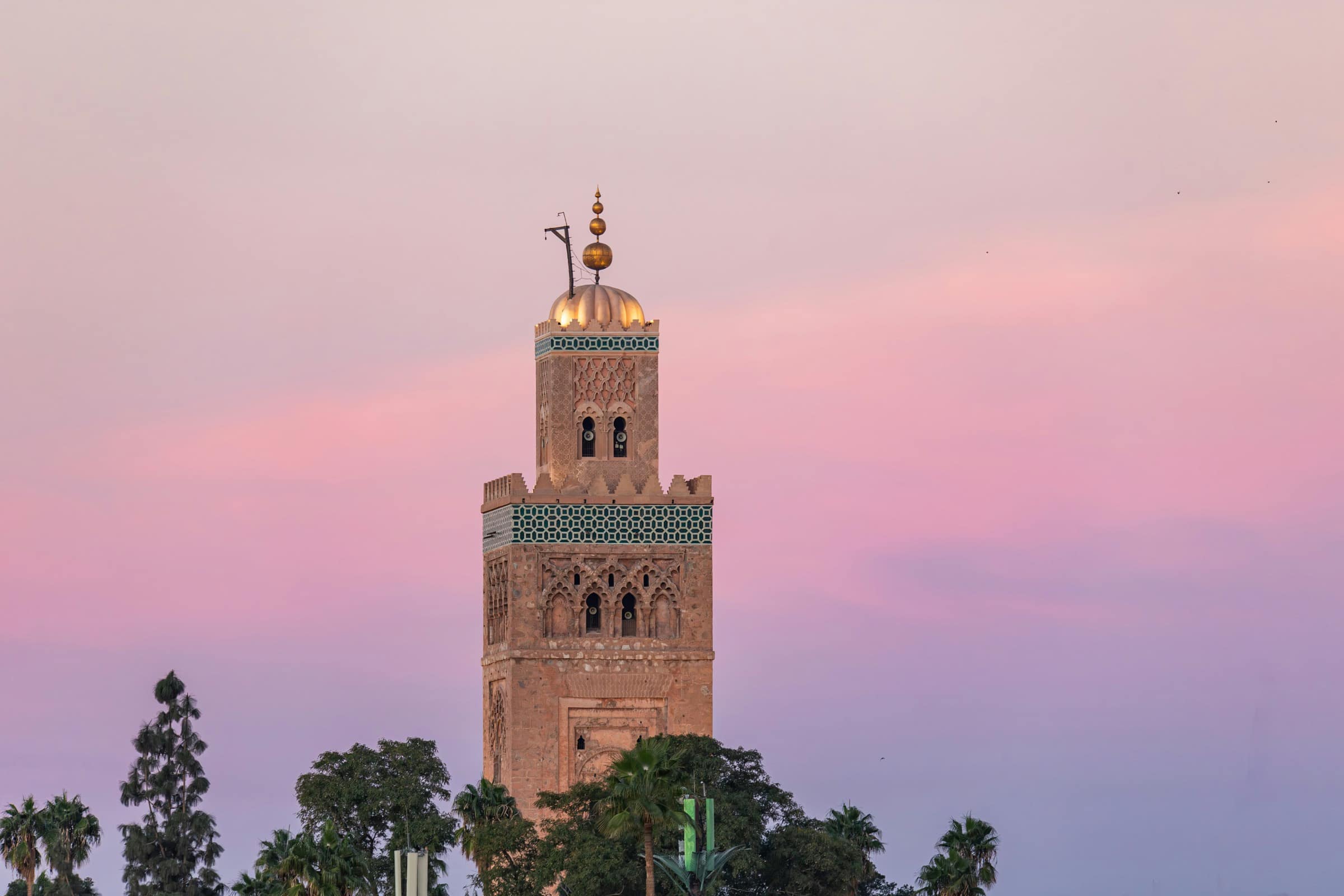
Mosques and prayers. A dense network. The Koutoubia (exterior only, the interior is kept for Muslims, as in every mosque in the country outside Hassan II in Casablanca), the Ben Youssef mosque, the Kasbah mosque and a hundred or so neighbourhood mosques. The call to prayer paces the day. Friday prayer (jum’a) runs around 1pm.
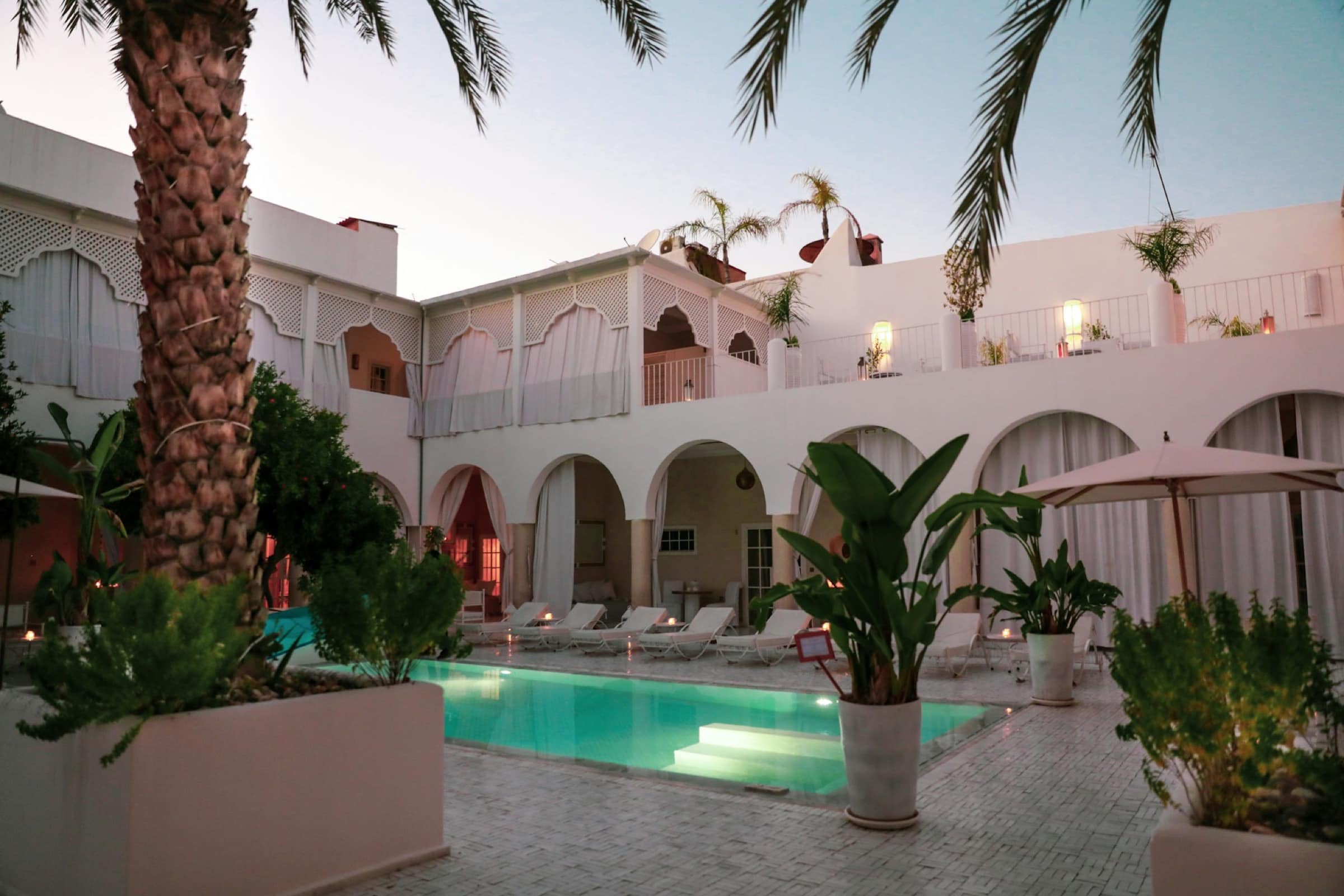
Riads. Most medina riads do not serve alcohol. Those who do announce it explicitly in their listing. Qur’an in the room is common but not systematic: to specify at booking. Qibla orientation is usually known by the riad staff.
The kingdom’s legal frame. Morocco is a constitutional monarchy (2011 Constitution). The King carries the title of Amir Al Mouminine, Commander of the Faithful, and guarantees the free exercise of worship. Islam is the state religion. But Moroccan civil law is not sharia applied as common law: it is mixed law, inherited from the French protectorate, crossed with Maliki Muslim law for personal status (the Moudawana, or Family Code). A Moudawana reform has been under way since 2023: royal commission, 139 proposals, seven amendments validated in late 2024 by the High Council of Ulema. Parliamentary adoption is expected in 2026. For a traveller, this changes nothing day to day.
The few watch points
Five points only, all simple to frame before your stay.
| Point | Stakes | Move |
|---|---|---|
| Visible alcohol | Palaces and public bars in Guéliz / Hivernage | Classic medina riad or Moroccan hotel chain |
| Mixed hammams | Mixed or couple slots at some tourist hammams | Public hammam (Mouassine, Ziani, Bab Doukkala): single-sex by default |
| Spa oils | Imported-oil origin on signature massages | Ask for the composition before the treatment |
| Mixed pools | Palaces, riads, shared villas | Fully rented private villa, or riad with no pool |
| Ramadan, non-Muslim side | Eating in the street frowned on, legal frame to know | Discretion, indoor restaurants (see below) |
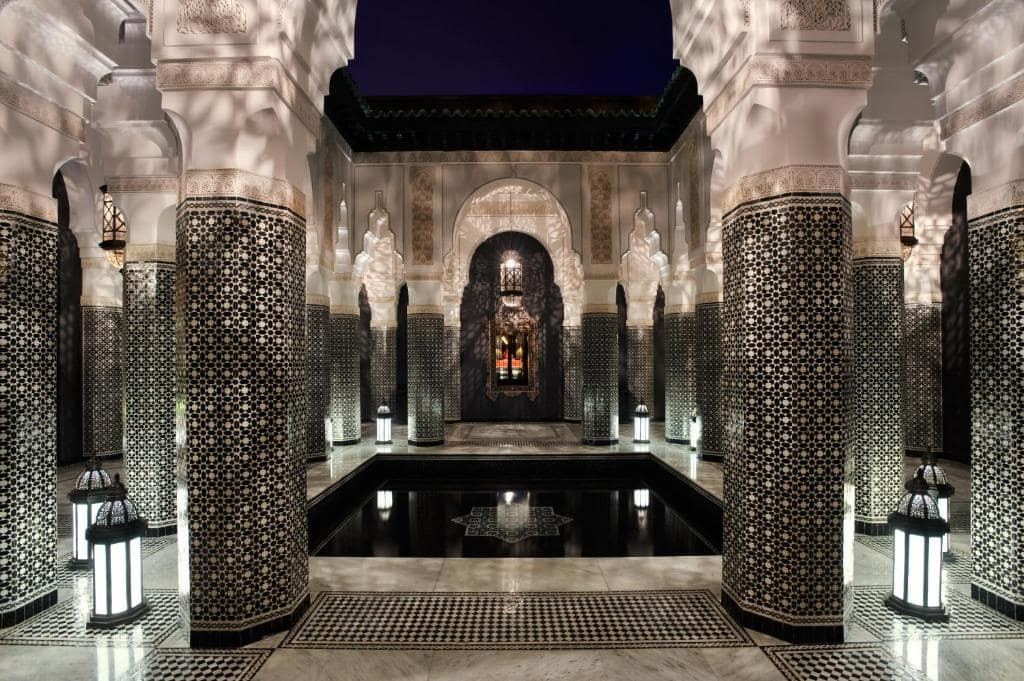
Visible alcohol. Marrakech palaces (Mamounia, Royal Mansour, Selman, Fairmont Royal Palm, Es Saadi Palace) all serve alcohol in 2026. La Mamounia runs four bars, the Royal Mansour adds a Cigar Bar and a Fireplace Lounge, the Selman has its bar, the Fairmont Royal Palm too. In Guéliz and Hivernage, a few public addresses (Kechmara, Baromètre, The Mix) offer cocktails and alcohol at £4 to £6 a glass. For zero exposure, pick a classic medina riad or a Moroccan hotel chain. For the non-halal mirror - Moroccan legal frame for alcohol, precise mapping of licensed venues, wordings to question a riad or palace without ambiguity - see Alcohol in Marrakech, the honest picture.
Hammams and mixing. The medina public hammams (Mouassine, Bab Doukkala, Ziani) are strictly single-sex, with separate men’s and women’s slots during the day. The modern tourist hammams (Bains de l’Alhambra for instance) sometimes offer mixed or couple slots: to ask about precisely at booking. Our wellness guide details the formats.
Spas and oils. Moroccan rituals rest on plant-based products (argan, ghassoul, nigella oil, olive-oil black soap). Nothing of animal origin enters the traditional ritual. On some signature massages with imported oils, it is legitimate to ask for the composition before the treatment.
Pools. Mixed by default in riads, palaces and villas. Fully rented private villas in the Palmeraie or at Amizmiz settle the matter through privatisation.
Ramadan for a non-Muslim traveller. Drinking and eating in the street is frowned on. Tourist restaurants open at midday welcome non-Muslims without issue, but you go there without ostentation and skip full-sun terraces. The medina slows down during the day and comes alive in the evening. Detail in Ramadan in Marrakech.
Picking your accommodation: three profiles that work
Classic medina riad, no alcohol. The simplest and most consistent format for a Muslim traveller. Moroccan breakfasts, local staff, family mood, usually total absence of alcohol at the table. Specify at booking: ‘no alcohol served, qibla orientation in room appreciated’. Most riads say yes without difficulty and without comment.
Moroccan hotel chain. Ryad Mogador, Kenzi (Farah, Menara Palace, Rose Garden), Zalagh Kasbah, Rawabi. International standards, absence or low visibility of alcohol (often kept in a dedicated bar you can skip), in-house hammam, Arabic-speaking staff. Practical format for a family or a business stay.
International palace with precautions. Doable but calls for sorting the services: garden-side room rather than pool, in-room breakfast to skip the mixed buffet, spa with oils specified ahead. The palace concierge is usually reactive and discreet. See our wellness in Marrakech guide for the palace detail.
Private villa in the Palmeraie or Amizmiz road. Often the best pick for a practising family on a long stay: kitchen and staff adjust, the pool is privatised, the mood is set. Coordination via a concierge or a rental-management agency (see our concierge guide).
Eating halal in Marrakech
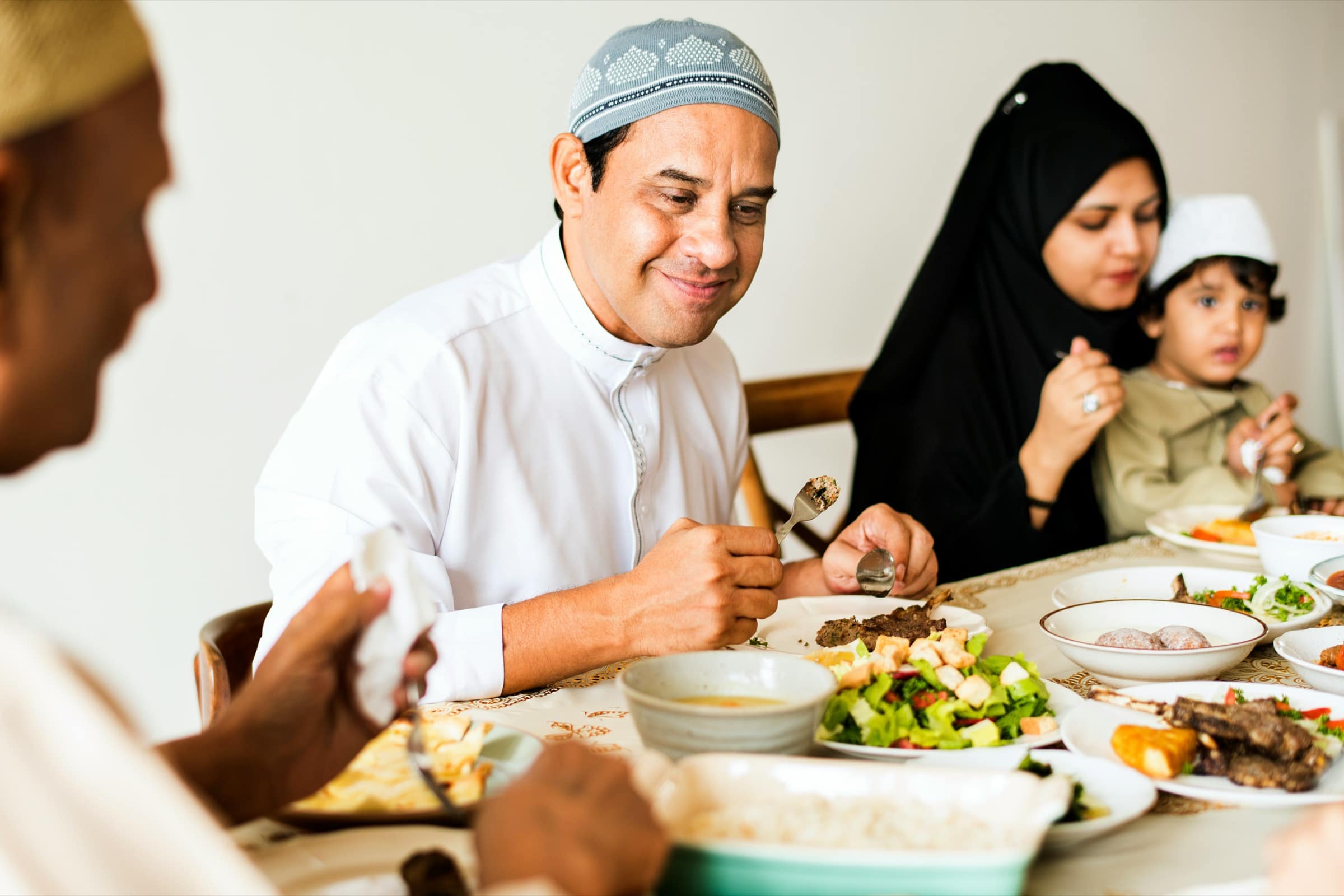
The rule. Ninety-nine per cent of Moroccan restaurants serve halal. Riad tables, Jemaa el-Fna stalls, Moroccan restaurants in Guéliz, new town included: served halal without mention because it is the norm. You will find neither pork nor a wine list at these addresses.
The exceptions. They concentrate in Guéliz and Hivernage, in French and Italian bistros aiming at an expat crowd: La Grande Poste, L’Adresse Guéliz, Le Bis Jardin des Arts, Catanzaro, Casanova. The card announces the cuisine angle (pepper steak, carbonara, tartare) and the wine list sits at the back. Nothing hidden, but worth knowing before booking.
Reliable signals before settling in: a bismillah on the entrance, a regular Moroccan crowd, no wine list on the table, the explicit ‘halal’ mention on the card when the restaurant also welcomes a non-Muslim crowd.
On the cooking. It is aromatic, not spicy. Cumin, ginger, cinnamon, saffron, coriander, ras el hanout: the heart of the repertoire. Harissa only comes with a few dishes (kefta tagine, skewers), to ask for on the side if you prefer. No Moroccan regional cuisine leans hot-pepper.
Ramadan in Marrakech: what changes
Muslim traveller. The mood is distinctive. Riads often host private iftars at the hour of maghrib, the souks come alive at night, the mosques fill for the tarawih evening prayer. Riad and restaurant bookings strongly advised, especially around ftour and for Eid. It is a period when the town lives differently, dense in mood and encounters.
Non-Muslim traveller. The town slows during the day. Tourist restaurants stay open, but the medina empties between midday and maghrib. The cultural rule: no consumption in the street, no full-sun terrace, you go inside to eat.
The legal frame, to know without dramatising: article 222 of the Moroccan Penal Code punishes with one to six months of prison and 200 to 500 dirhams of fine ‘anyone who, notoriously known for their belonging to the Muslim religion, breaks the fast openly in a public place during Ramadan’. The text targets explicitly Moroccan Muslims identifiable as such. Foreign tourists and non-Muslims are not targeted. In practice, discretion applies out of respect, not fear.
Eid al-Fitr. The town practically stops for two to three days. Souks closed, restaurants running on skeleton staff, families gathered. A good moment for the Palmeraie, the Atlas or a run out of the souks. Plan your shopping and bookings ahead.
Friday prayer, mosques and practice
Friday prayer (jum’a) runs around 1pm at the big mosques in town: Koutoubia, Ben Youssef, Kasbah and the neighbourhood mosques. As across the country, mosques have been kept for Muslims since the 1912 dahir. A non-Muslim therefore does not enter a mosque in Marrakech. The esplanade and gardens of the Koutoubia stay open.
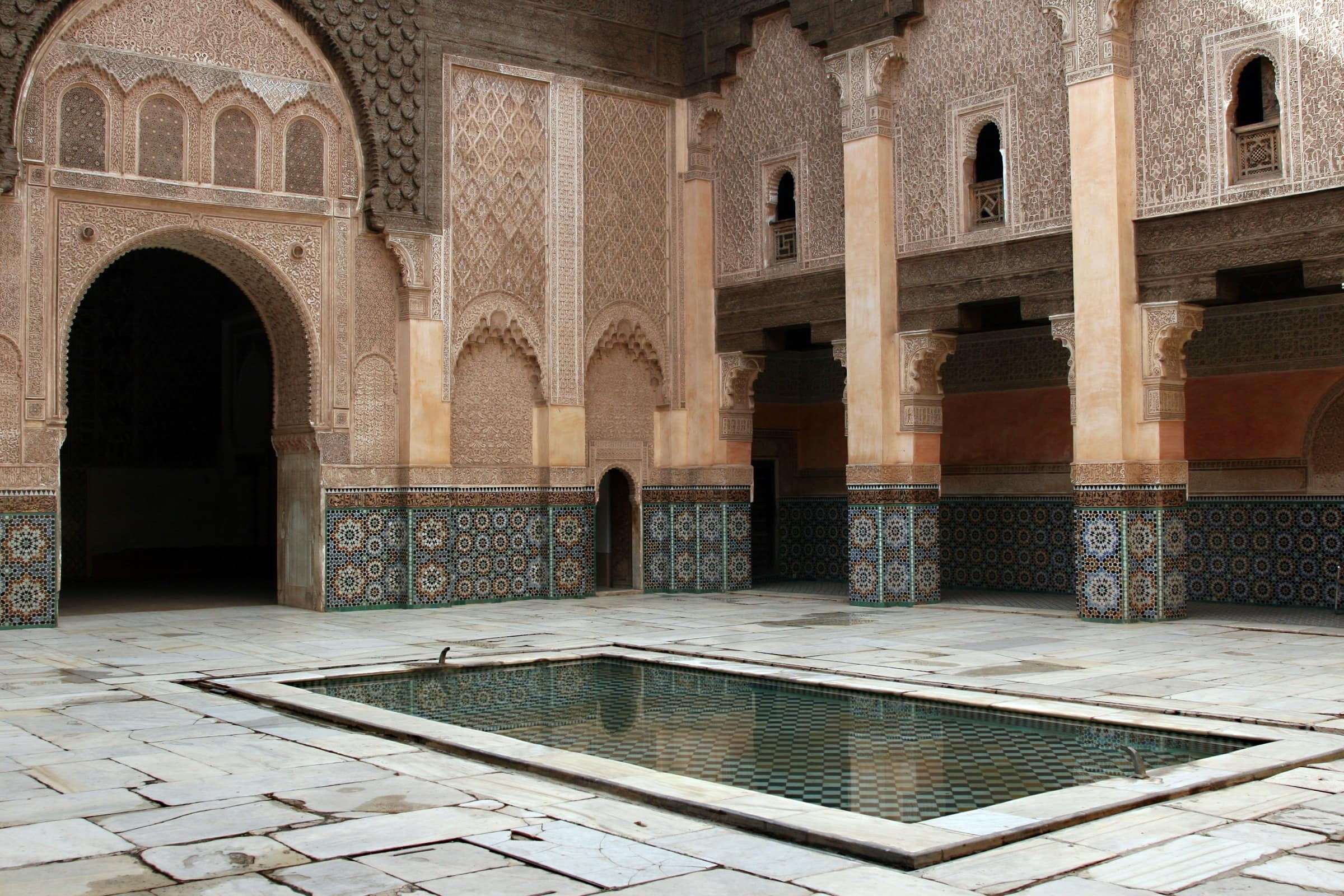
A useful distinction for a curious traveller: the Ben Youssef Medersa, a Qur’anic school restored between 2018 and 2022, is open to all (£4 entry, 9am to 7pm). The Ben Youssef mosque, next door and same name, stays closed to non-Muslims. Do not mix the two up.
The qibla from Marrakech. Direction east to east-south-east. The distance to Mecca is around 4,850 km. A great-circle calculation and a rhumb-line calculation give two slightly different values. In practice, most riads know the orientation in their rooms. If in doubt, an app (Muslim Pro, Athan) confirms it in a second.
Five questions to ask your riad before booking
What halal travel does not cover
To stop this guide reading like an agency brochure, four straight points.
A halal trip is not a stay with no mixing in the street. Marrakech is a town where women and men cross paths everywhere, in the souks, taxis, cafés, on Jemaa el-Fna. Public-space mixing is the norm in Morocco.
Nor is it total absence of alcohol in the public space. The palaces, the bars in Guéliz and Hivernage, the boutique riads welcoming an international crowd exist and are visible. Skipping them is a choice. Denying them would be false.
It is not a religious destination in the strict sense. Marrakech is a town in a Muslim country, which does not make the town a place of pilgrimage. The Umrah and the Hajj happen in Mecca. Morocco holds places of spirituality (Fez, Chefchaouen, the Seven Saints tombs in Marrakech for the Sufi tradition), but they are stopovers, not pillars of a standard tourist stay.
Nor is it an identity simplification. A Muslim traveller is a traveller. They come for the medina, the light, the cooking, a birthday, a public hammam bath, walking the Atlas. Their religious practice frames the stay without summing it up.
Specialist agencies: when they make sense
Cases where an agency makes sense. Group trip organised by a mosque or an association, large families that want to cut the decisions, elderly people or a first trip to Morocco without familiar English/French support. The agency coordinates alcohol-free accommodation, transport, meals, sometimes an Islamic-heritage itinerary (Fez, Meknes, Volubilis, Idris tomb at Moulay Idris Zerhoun) that goes beyond Marrakech.
Cases where it does not. Individual or couple traveller, English- or French-speaking, self-reliant. Marrakech is booked directly, riad by riad, restaurant by restaurant. An agency margin then only brings a peace-of-mind guarantee the traveller can secure alone.
Among French-speaking specialist players, the halal travel concept is offered by operators such as TravelMuz, a French agency specialising in halal circuits (Morocco, Turkey, Bosnia, Umrah, Zanzibar), active since 2016 and registered Atout France. An editorial comparison point to place the offer, without this guide recommending any agency in particular.
Going all the way
This guide gave you the frame. For the concrete planning of your stay, the following sheets take over.
- To set the season of your stay (including Ramadan and Eid): Best time to visit Marrakech.
- For hammams and spas, with the detail of mixed and single-sex formats: Wellness in Marrakech.
- For coordinating a family stay or an event (wedding, birthday) with a property manager or an on-site concierge: Private concierge in Marrakech.
- For the Koutoubia mosque (exterior), esplanade and gardens: our Koutoubia sheet.