A Sunday morning at Bab Doukkala, the medina's real rhythm
Stories & notebooks
Bab Doukkala, a Sunday at seven. The medina does not pretend. The crates of the Palmeraie market gardeners are down, the first muezzin fades into the echo of the others, a child walks across the alley with a plank of bread on his head. The Moroccan Sunday is not the European Sunday. Here is what I see when I come here before eight.
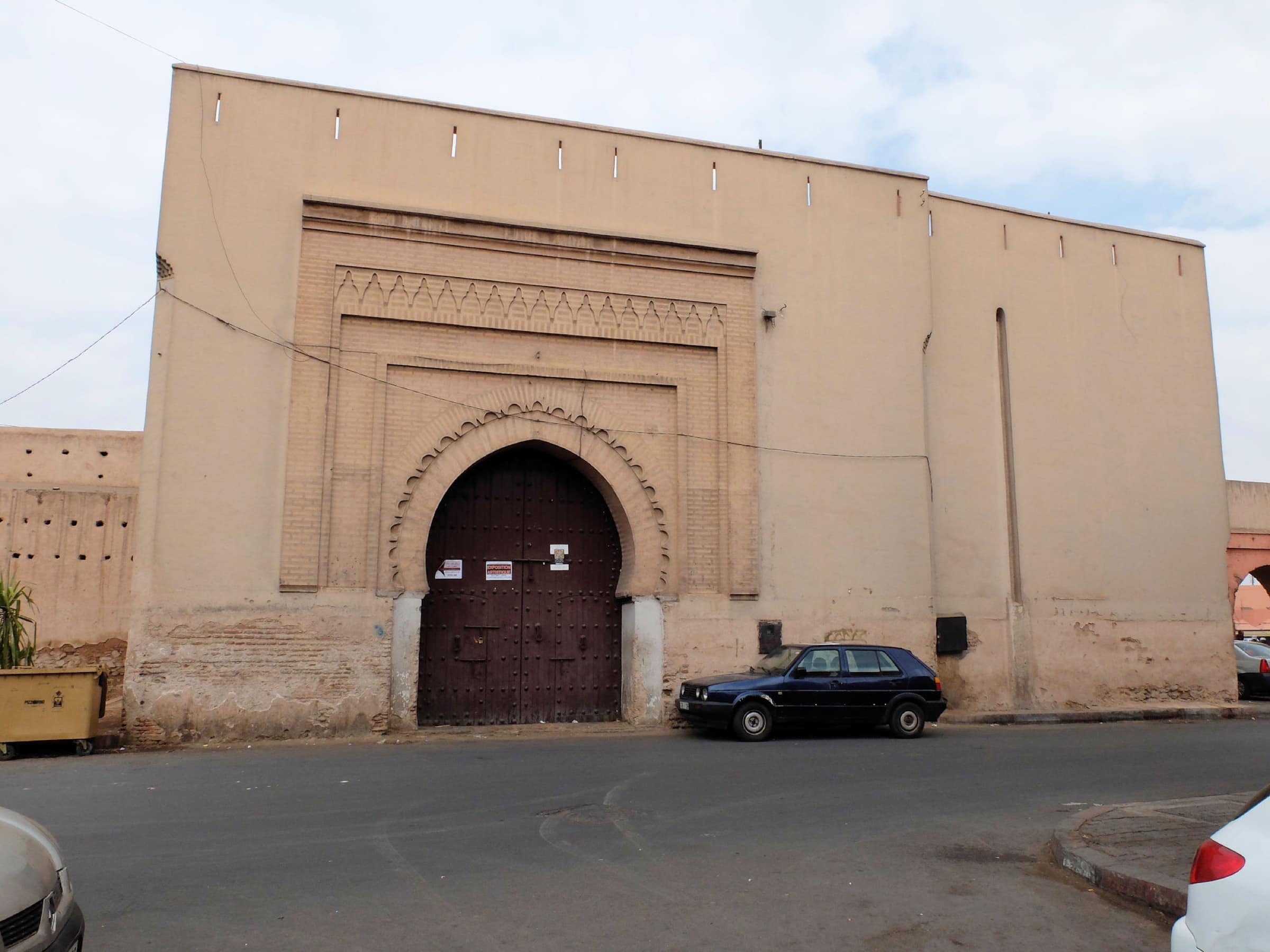
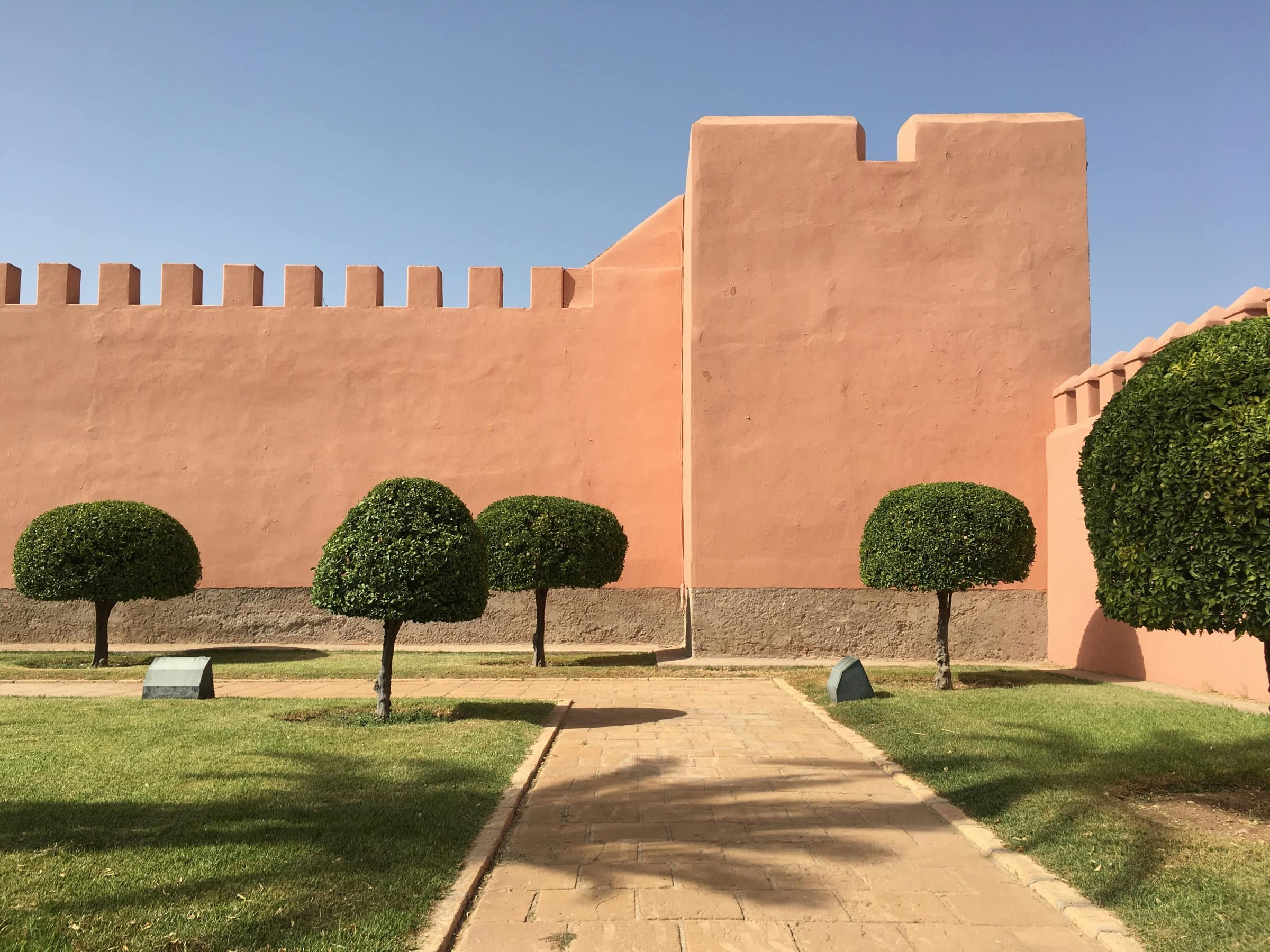
It is six forty-five at Bab Doukkala. I set out from Guéliz on foot twenty minutes earlier, the new town still empty, one or two taxis heading back from a long night. The gate shows up at the corner of the ramparts at the end of Mohammed VI avenue: squat, ochre, two square bastions flanking it, the mosque just behind. The first muezzin fades as I get closer. The echo of the others picks up, two or three seconds late, over from the Sidi Bel Abbes zaouia to the north and from the Koutoubia to the south. I go through the gate.
What really sets a Marrakchi Sunday apart
Sunday is not the weekly break here, and that is a misreading that makes you miss this kind of morning. It is an administrative inheritance from the French protectorate: offices, schools, banks, administrations, everything state-related shuts. The new town, Guéliz and Hivernage, is quieter than a Tuesday. But the medina does not stop. Souks, popular markets, cafés, ferrans, corner grocers - everything runs. Craftsmen are there. Women do their shopping. Handcarts deliver.
The real rupture day in Morocco is Friday. Midday prayer, jom’a, often followed by the family couscous - the souks empty partly between eleven and four, many workshops shut for prayer and reopen in the afternoon. A Friday morning at Bab Doukkala, the medina is already getting ready for that shift, you feel it. A Sunday morning, it is in its ordinary regime, the one most European travellers never see because they are asleep.
Going through the gate, Almoravids and Lalla Mas’uda
The gate I have just walked through dates from the twelfth century, under Ali ibn Yusuf, around 1126-1127, when the Almoravids close off the first complete perimeter of the town. It was reworked by the Almohads, which explains its hybrid style. Its singularity: the bent-axis double angle, a defensive setup rare in Marrakech, calibrated to slow down a mounted attacker. Two asymmetric square bastions, the south-west one wider than the other. Since 1989, one of the bastions has held an exhibition space from the Ministry of Culture - irregular hours, but the exterior entry neither charges nor announces itself.
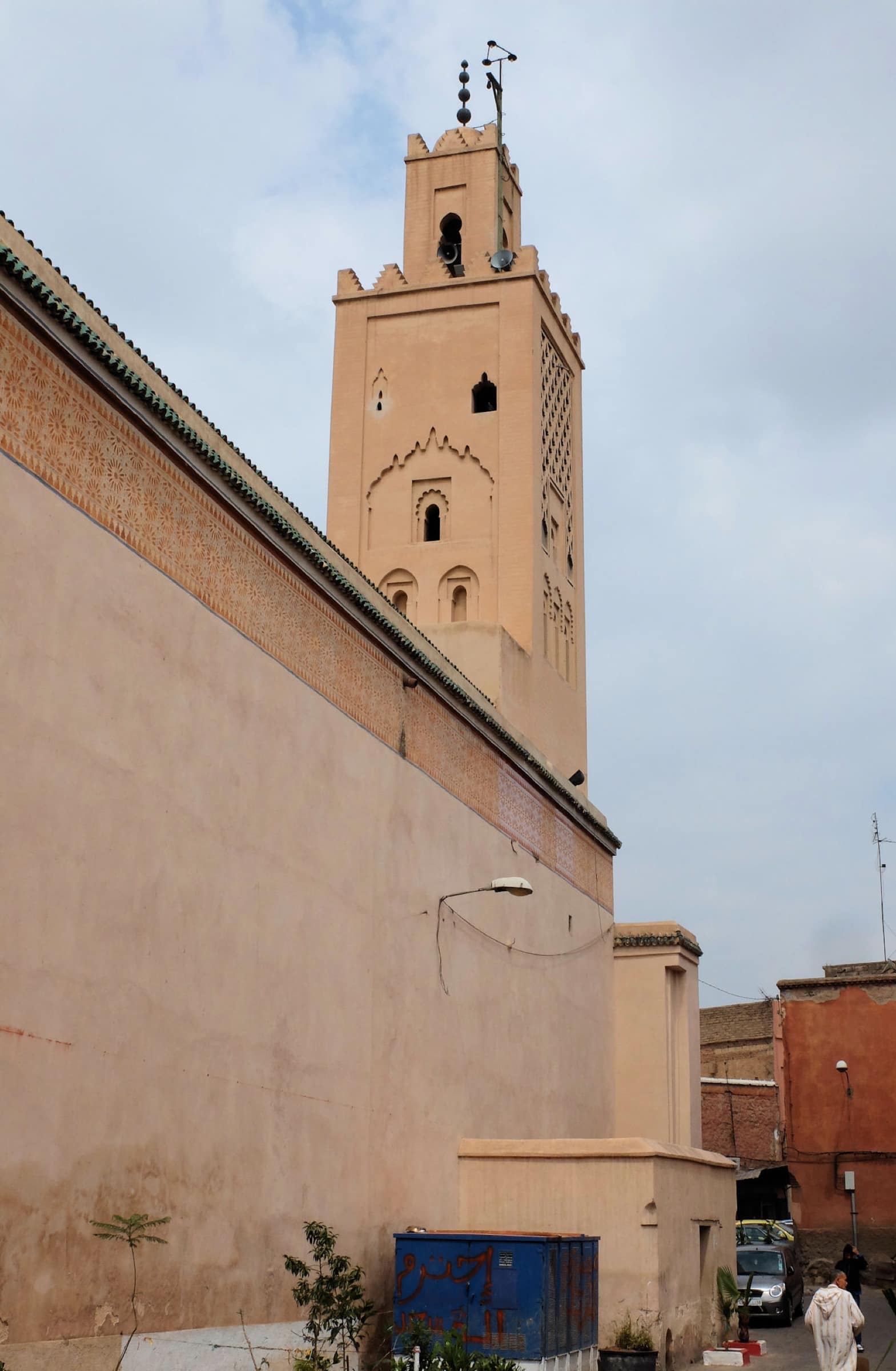
Immediately inside the gate, the mosque. Its official name is Jami’ Bab Doukkala. Its other name, more telling, is Jami’ al-Hurra: the mosque of the Free Woman. It was built between 1557 and 1571 under Moulay Abdallah al-Ghalib, at the initiative of Lalla Mas’uda bint Ahmad. A woman, then, at the origin of one of the town’s great religious foundations. She was the wife of Muhammad al-Sheikh, founder of the Saadian dynasty, and the mother of Ahmed al-Mansour who would make Marrakech the world-city of the Songhai and the embassies. “The Free Woman” refers to the free-woman status recalled by that name. The original complex included a madrasa, a public hammam, a fountain, a library, latrines. The hammam has closed, the fountain still runs a little further on. I do not enter the mosque - it is the general rule in Morocco, reserved for Muslims. I go round through the northern alley.
The market, the real window is short
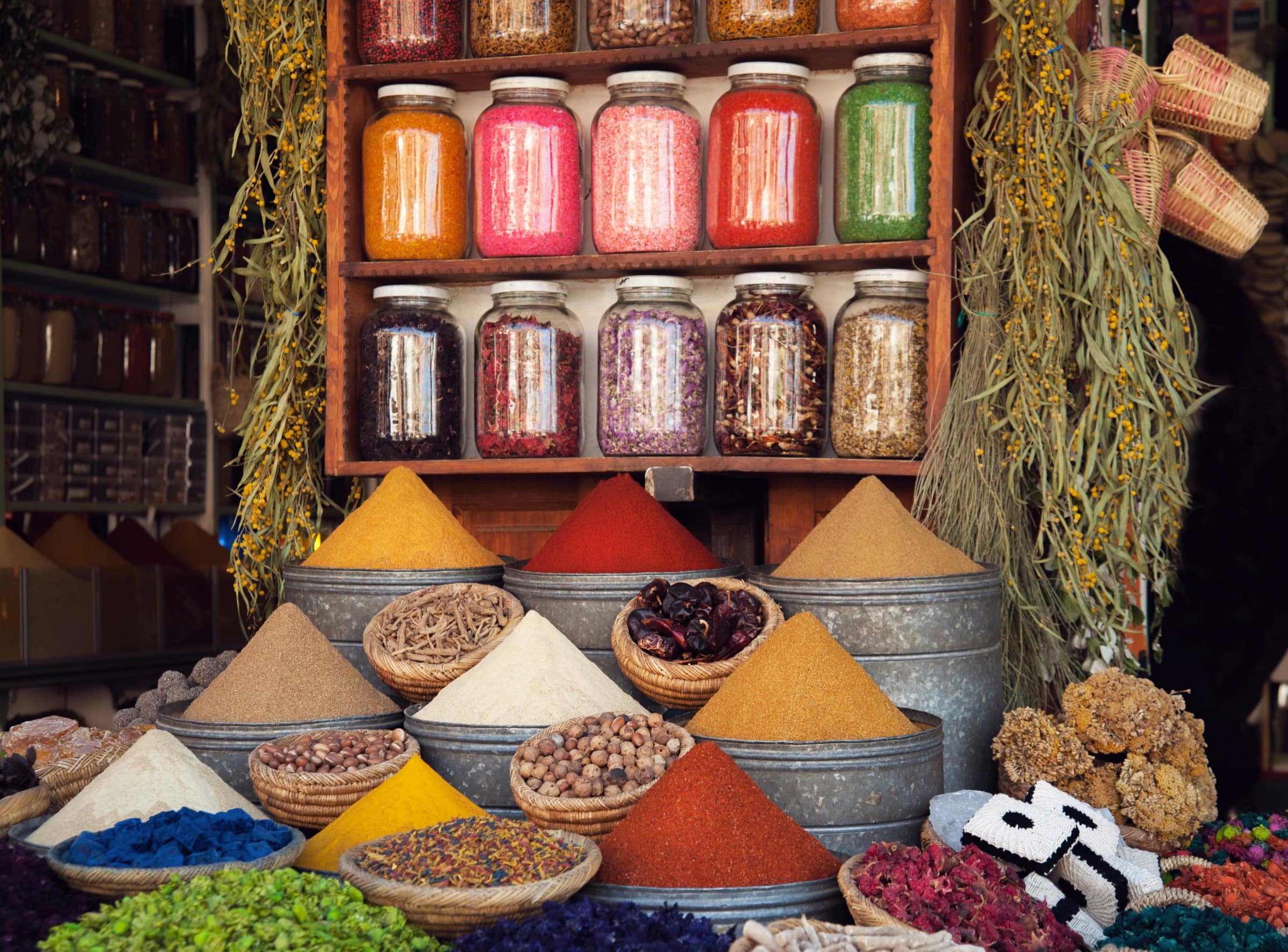
A hundred metres past the gate, I am in the market. This is not a tourist souk. It is a neighbourhood market - fruit, vegetables, fresh meat, fish, olives in zinc trays, preserved lemons in jars, herbs in bundles, spices in newspaper cones, a few fresh cheese stalls. Prices are low because this is semi-wholesale: this market supplies the derb riads, the alley restaurants, the neighbourhood family kitchens. What comes from the Palmeraie and the Ourika valley arrives at five in the morning. By seven, everything is in place. By eleven, what is left has wilted. The real window is there, first thing.
I stop in front of a mint seller who cuts the bundles with a blade. Moroccan mint is darker, denser in essential oils than what you find in France. It serves tea, salad, tagine. A woman buys five bundles for ten dirhams (£0.80). Three alleys further on, a butcher bones out a half sheep on a block, quick precise silent gesture. He will have sold out his stall before noon.
The ferran, this silent institution
The real high point of a Sunday morning sits a little to the side, in a recess three alleys south of the market. The ferran. The communal oven.
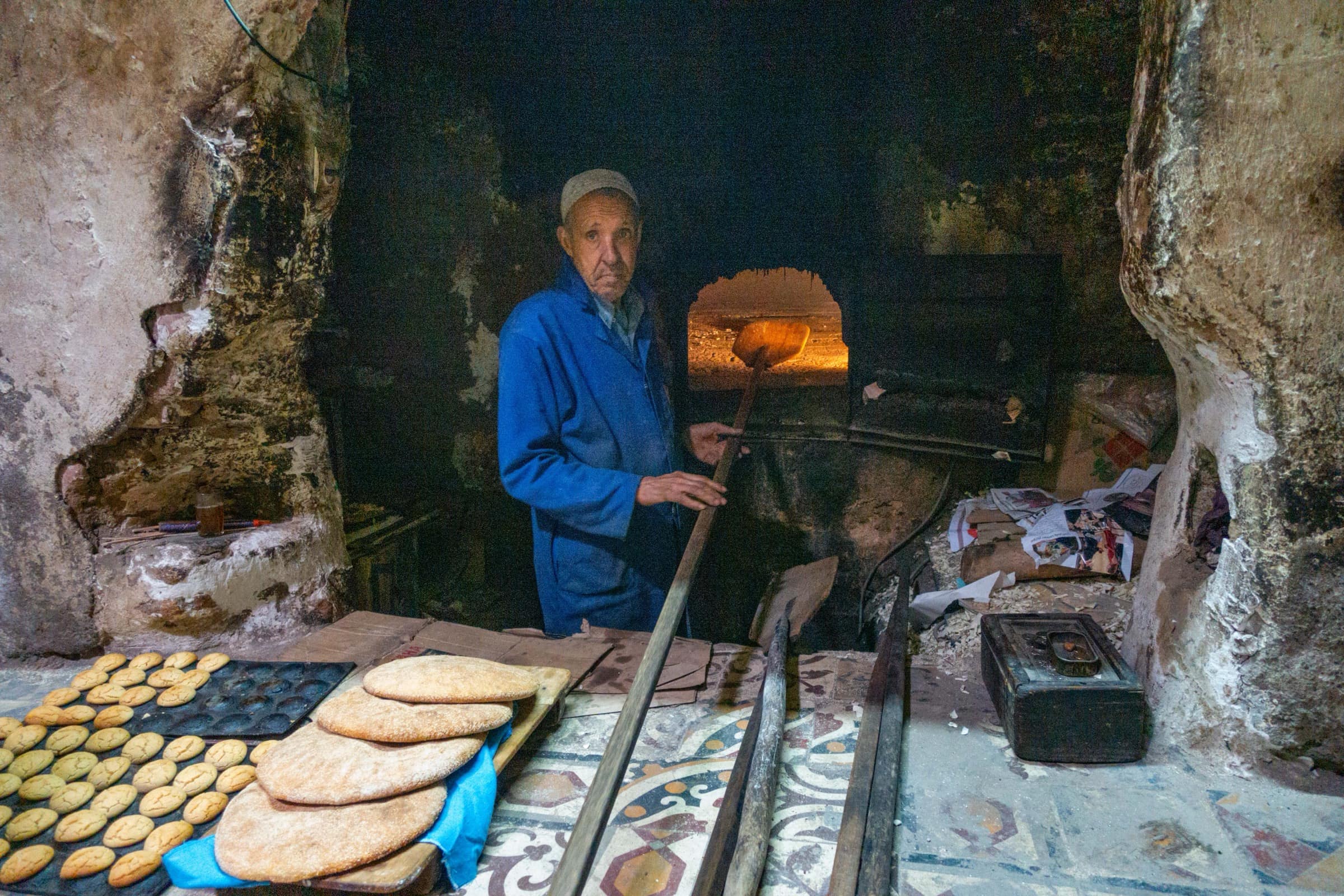
I am not going to name one precisely - this economy works better when it stays anonymous, off the queues of the curious. What I can describe is the system. Marrakchi families knead their bread at home. The khobz beldi, that round semolina bread that accompanies every meal, is prepared first thing in the morning, left to rise for an hour, then carried to the ferran on a wooden plank. The baker, often a single man, sometimes two, bakes them in sequence in a large wood-fired oven. For a few dirhams a batch, he hands the bread back an hour later, golden, still warm. The women of the quarter come by, leave their plank, come back to collect. They cross paths, they talk. The ferran is a social space as much as a food space, a silent institution in the working of Moroccan medinas.
The morning bread vocabulary is worth setting out. Khobz beldi is the base, round, dense, full. The msemen is a square puff, cooked on the pan, both crispy and pliable, rolled in a napkin and sold on the way out of the café. The baghrir is a thousand-hole pancake risen with yeast, served with honey and melted butter - the pancake of children and Sundays. The harcha is a dense semolina flatbread, more rustic, cut in two and stuffed with olive oil, amlou or fresh cheese. The meloui is a puff spiral, oilier, kept for winter mornings. These five are morning bread. I never find them at dinner, and rarely in a family kitchen: this is the bread you go and pick up outside.
A child crosses the alley with a plank on his head. He must be nine or ten, he holds the plank with both hands, he has the natural balance of children who have done it a hundred times. The image is documented from the 1950s on in Moroccan archives. It is still there in 2026.
The working café, zellige counter and Al Jazeera
The morning working café is a genre in itself. It has no highlighted signage, no Instagram terrace, no menu in English. Zellige counter, plastic chairs lined up facing the street, TV on Al Jazeera or a replayed match and a clientele that is almost exclusively male - taxi drivers, delivery men, workers from the nearby building site, craftsmen before their workshops open. I order a nous-nous, half coffee, half hot milk, the default morning drink in Marrakech. Under a pound. The owner drops a piece of msemen he has just rolled in honey on the same saucer.
This is the ordinary café, the one on the street. Not Café des Épices, not a riad rooftop, not the shaded terrace of a restaurant that opens at midday for visitors. It rarely closes, has held on for twenty or thirty years, does not reinvent itself. I come here when I want to see the medina live without mediation, and I pay half what I would in Guéliz.
Around the gate, what I look at without turning it into a set
There is still a small half-hour before the neighbourhood tips fully into its day regime. I take the alley that runs along the north side of the mosque.
The Bab Doukkala fountain. Small, plain, still supplied. It is the start of what Moroccan guides call the water itinerary, a historical trace that linked the great public fountains of the medina through to the Riad Larousse one. The town had a whole underground supply network, the khettaras, inherited from the Andalusian and Alaouite know-how. The fountain still bears witness to that forgotten infrastructure.
The studded door of the Riad Kniza, a few metres away, at 34 Derb L’Hotel. I cross it every time. There are many studded doors in the medina, but this one tells two centuries: the same family has lived here for around two hundred years, the former owner, the late Haj Mohamed Bouskri, a former guide to heads of state and celebrities, restored it and turned it into a boutique-hotel. I could have slept there. I cannot walk in without reason. I move on.
Northwards, five hundred to seven hundred metres on foot, sits the Sidi Bel Abbes Zaouia. It is often confused with Bab Doukkala because it is in the same extended quarter, but it is in the extension, on the Bab Taghzout side. Sidi Bel Abbes is the patron of Marrakech, one of the seven saints, honoured on Thursdays. The zaouia itself is closed to non-Muslims, but its minaret and outer courtyard are visible from the alleys. A walk to add if I want to continue.
Finally, in the alleys around, hand-pulled or mule-drawn carts and the porter-carts in particular: an official profession, negotiated fare, they are what makes the medina deliverable. Without them, the riads with no vehicle access would be impossible to run. I watch them go by. They are the invisible infrastructure of the quarter.
Five reflexes for this slot
To take it further
- For the full history of the gates and the Almoravid and Almohad ramparts: our ramparts and gates listing.
- For a totally different spice market, 800 metres south: Place Rahba Kedima.
- For dawn light in the medina, street photography ethics, the windows to know: Photographing Marrakech, field notes.
- For the town’s street food map, off the tourist zone: our street food guide.