Souk Sebbaghine, a morning between indigo and madder
Stories & notebooks
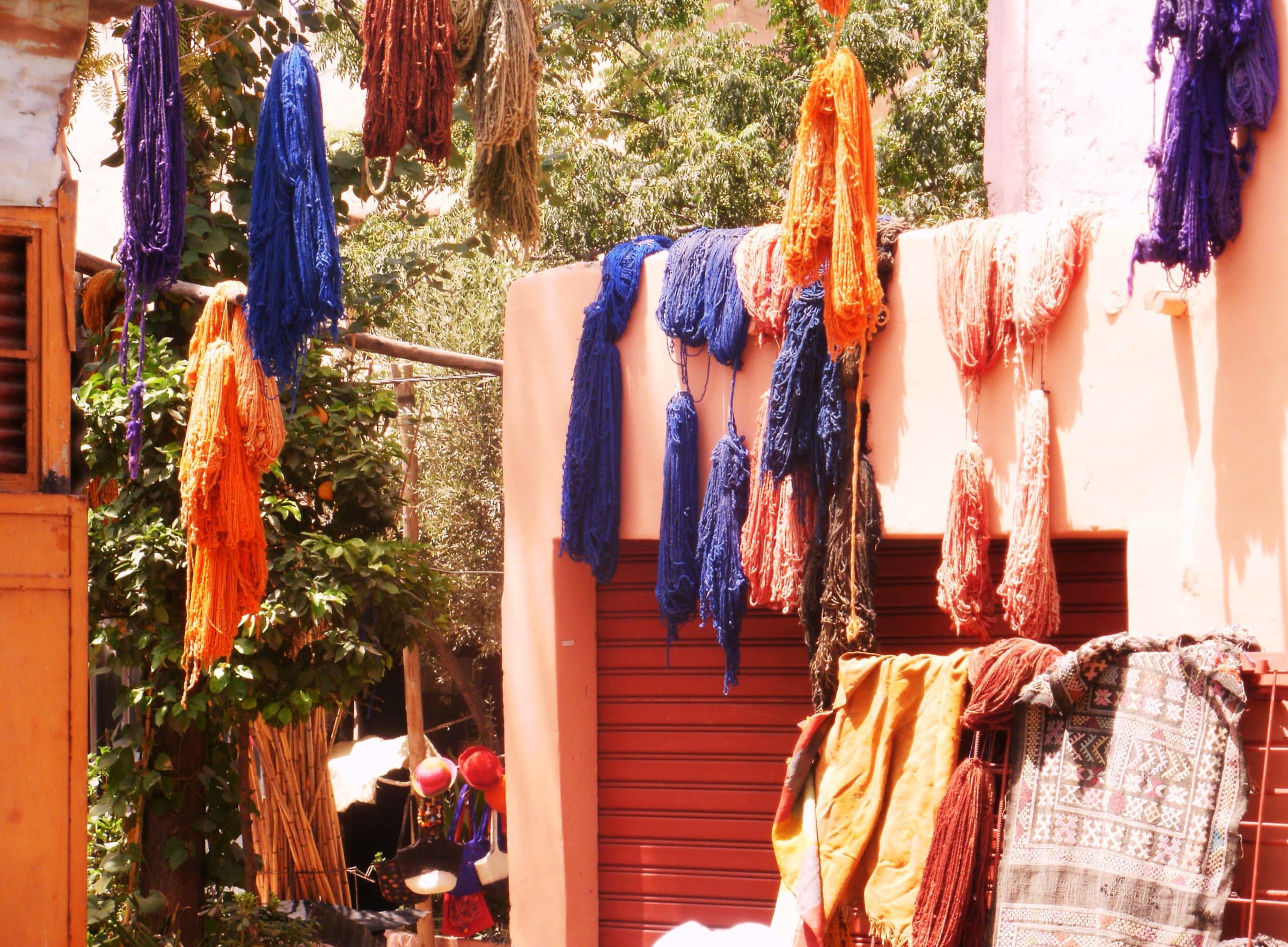
Nine-ten, past the Mouassine fountain arch, sharp angle to the left. I step in. Twisted wringing on the stick, blue drops falling from the skeins into the alley. Souk Sebbaghine is in full swing, and its window is short.
I set out from the square at 8.40am. Semmarine still quiet, a few traders unpacking, the axis nearly walkable without slaloming. I followed the track I have taken a thousand times: due north for three hundred metres, Mouassine fork left at the level of the kissaria, the Mouassine fountain on the right, the widening lined with lamp shops, the sharp angle to the left. The word “teinturies” in spray paint on the wall, my beacon. I step in. Nine-ten.
There is two hours to it, no more
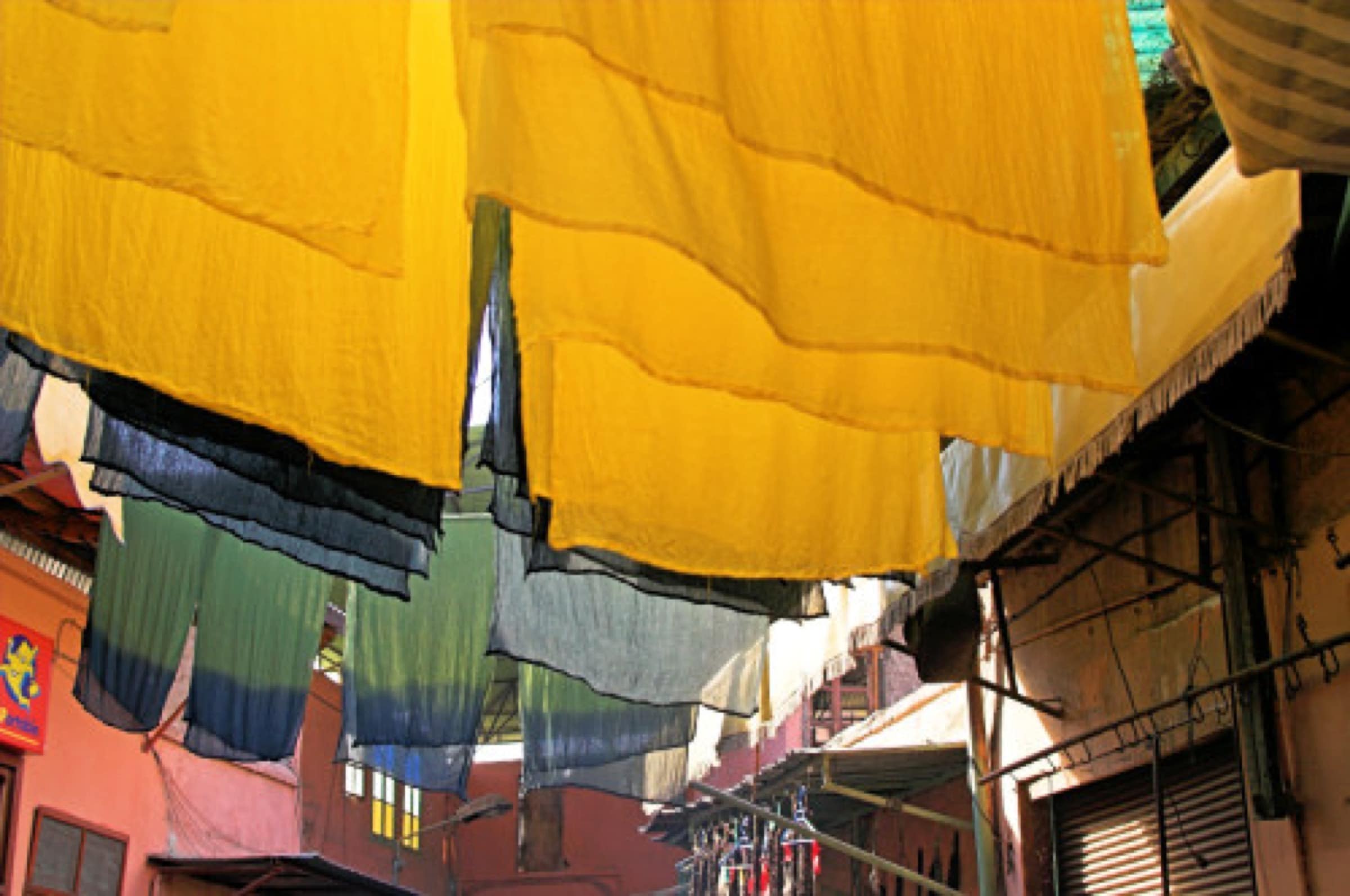
This souk holds from 7am to 11am. After that, it is over. The open-air vats, heated on wood before dawn, gave their first baths from 7.30am. By 9.30am, the skeins come out, wrung on a stick by hand, hung above the alley to dry. That is when grazing light still finds a corridor between the walls to come in, when colours saturate with fresh humidity, when the ceiling of stretched wool catches fire. By 11.30am, the flat shadow eats the contrast, the craftsmen head in, activity stops. Back in two hours. The vats do not take the midday sun - the hot water evaporates, wet skeins cook instead of drying.
What I see when I step in
The first maâlem I cross has forearms blue up to the elbows. The colour does not come off in one wash, or two, or a week. It marks the skin. It is the sign of an indigo session the day before - the colour that stains the most. He twists a skein on the stick, wrings out the bath, hangs it on a rope stretched across the alley, at head height. Blue drops on the beaten-earth floor.
Three vats further on, a second indigo vat. Then a madder red. Then a saffron-flavoured yellow, rarer, pricier. The principle is simple: one colour per vat, one vat per craftsman, one family per vat. Indigo vats are the most precious. A maintained indigo vat lives for years. You have to feed the fermentation, keep it warm, never let it drop. The bacterium dies if the vat cools too much. You do not restart an indigo like you re-light an oven.
The vocabulary of colour
Indigo, from Latin indicum (“from India”), is Indigofera tinctoria. It gives deep blues that shift from sky blue to navy depending on the number of dips. The vat ferments, it smells of the characteristic sweet-sour and the hands that come out of it stay blue for several days.
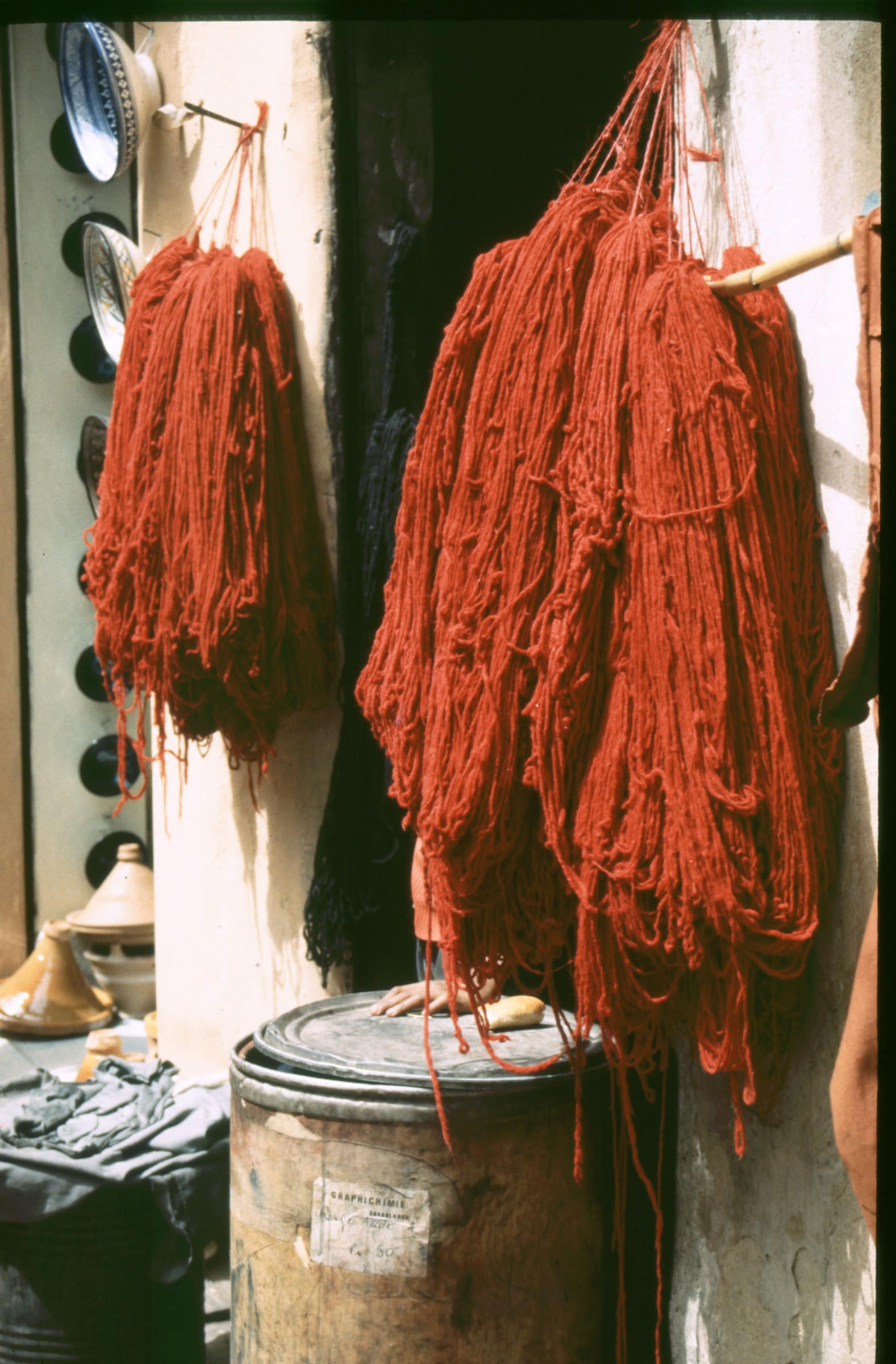
Madder, Rubia tinctorum, a root. It gives alizarin, a classic medina-carpet red. Mordanted with alum or crushed bitter-orange juice, it turns deep red. Without a calcium mordant it shifts to orange.
Saffron, bright yellow and expensive, kept for precise orders. In Marrakech, real saffron comes from Taliouine in the Anti-Atlas. Watch for the fake, often in fact safflower, cheaper, duller.
Henna for russet browns, pomegranate for a tannic yellow, mastic pistachio for greens, imported cochineal for carmines.
The rest - the lemon yellows, the fuchsias, the turquoises that sometimes come out - come from industrial anilines. Brighter, faster, cheaper, less lasting. Natural dye survives mostly for orders from High Atlas weavers, from carpet cooperatives and a few eco-responsible workshops. It is not the daily norm.
The gesture
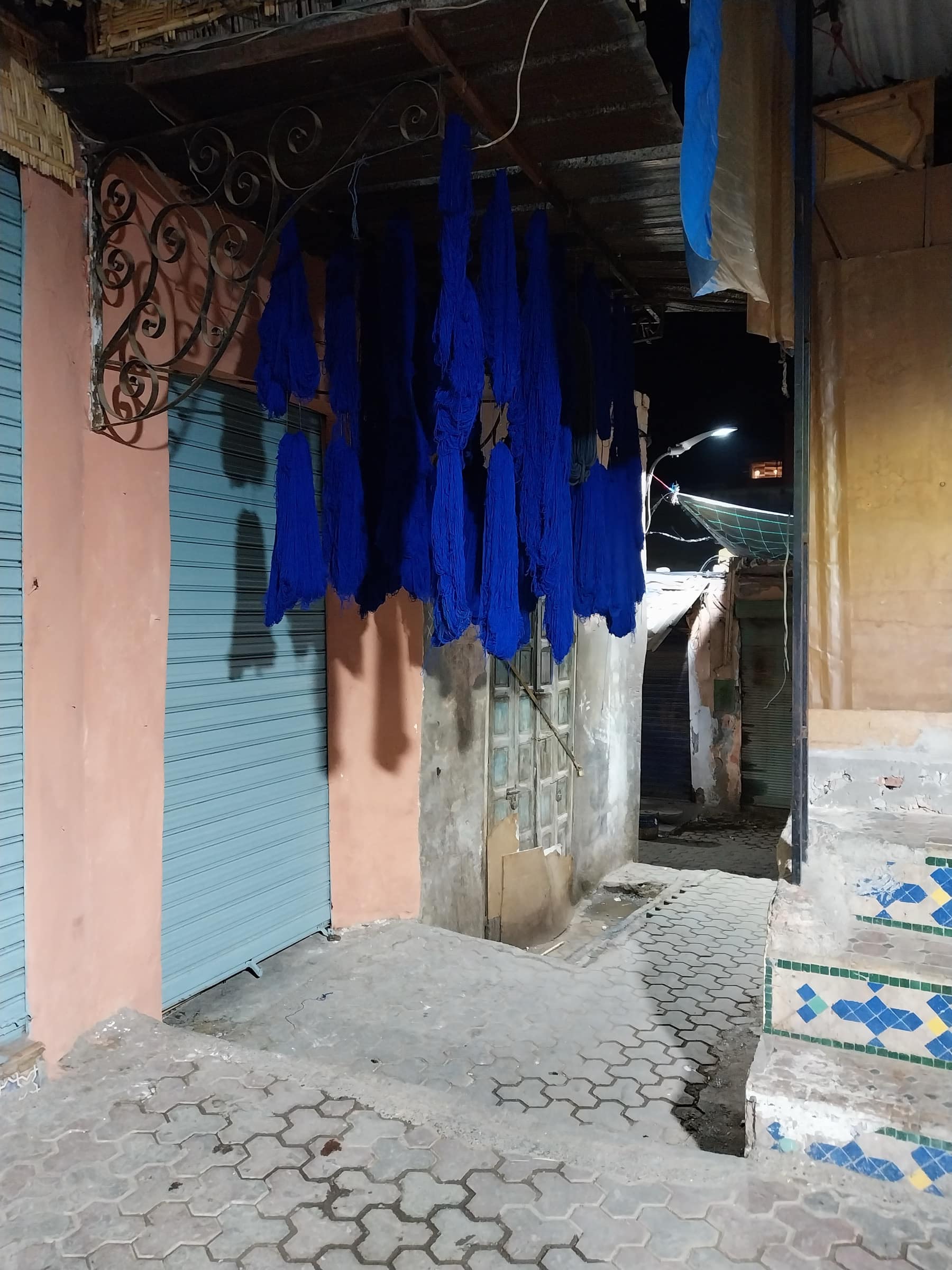
Dip 30 minutes to several hours depending on the colour and the depth wanted. The vat is heated on wood or gas, the water climbs to 60 to 80 degrees depending on the dye. The skein goes in, is stirred, is turned. Out, twisted wringing on the stick - two precise moves, one twists, the other unloads - air-drying hung above the alley. One craftsman per vat, often on his own. Concentration, silence. No touting. It is a workshop more than a shop.
Some stalls also sell on the way out. Bundles of dyed wool, by the unit of 500 grams to 1 kilo. The end buyers are not tourists. They are the weavers of the Ourika and Aït Bougmez valleys, the carpet cooperatives of Ouirgane, the linen embroiderers, the neighbouring leather workshops who come and pick up reds to dye morocco leather. The commercial chain sets off from here and goes back up the High Atlas or crosses the medina to the Cherratine souks, five hundred metres east.
What I do not buy, what I can buy
If I step in to look, I pay zero. I watch, I step aside when a craftsman goes past with a wet plank, I do not stand in front of a vat.
If I want to buy, I ask to see the wool dry, not freshly wrung. An unstable dye loses 20 to 30% of its colour on the first wash, you see it on a skein that has spent the night. I negotiate by the kilo, not by the bundle. I ask about the dye, openly: natural or aniline. The answer is open too - craftsmen do not hide when it is industrial, they follow their client’s order. Natural, you have to ask for upstream, pay a bit more, accept the duller palette.
A craftsman offers me the hand-in-the-vat demo for 50 dirhams (£4), bill at the end. I pass. The classic paid show of the tourist souk runs a lot here because the colours photograph well. What gets seriously dyed this morning plays out three vats further on, on a carpet order - where nobody is looking for the lens.
The red alley, the yellow alley, the morning lottery
The Instagram image, the “red alley” or the “yellow alley” with the monochrome ceiling of stretched skeins above, does exist. It is real but random. What hangs above the walls on a given morning depends on the previous day’s orders, not on a schedule. One day it is all red because a carpet cooperative ordered fifty kilos. The next day it is yellow because a Berber weaver is finishing a babouche order. Sometimes the alley is empty because nothing was dyed the night before. Chance decides. What counts is being there between 9.30am and 11am and taking what is on offer.
Photographing here, what I hold myself to
Window 9.30am to 11am for humidity-saturated colours and the still-passing grazing light. Ask before every close frame on a face, show the screen, leave a tip if the exchange settles. The wide frame on the alley with skeins strung above shoots without issue, nobody is identifiable in it. The close portrait on a craftsman wringing, never without his agreement in a gesture - common refusal to respect. No flash. No selfie stick blocking the alley and hindering the work.
These rules apply to the rest of the medina too. I laid them out in Photographing Marrakech, field notes.
Stepping out
At eleven-ten, I pass the Mouassine fountain again. The souk empties out of its morning window. Vats cool, craftsmen pack their sticks, the morning’s dried skeins are taken down and folded. In two hours, the second wave picks up, less intense - the light will no longer earn it.
Three reflexes for this window
To take it further
- For the practical entry point of the place (address, hours, what you come to look for): our dyers souk listing.
- For the spice square right to the south, an obvious morning complement: Place Rahba Kedima.
- For the main souks axis that leads here: Souk Semmarine.
- For the downstream link, leather dyeing: Souk Cherratine.
- For medina photo ethics and the light windows: Photographing Marrakech, field notes.
- For another sector, another morning, another rite: A Sunday morning at Bab Doukkala.