Shopping in the Marrakech souks: the guide
At the dyers' souk, saffron and crimson wool skeins dry stretched above the alley. Thirty metres further, dyeing gives way to hammered copper. Nothing sits at random in the Marrakech souks: each trade holds its lane. Reading them, and haggling without getting caught out, turns a passive wander into a real shopping pleasure.
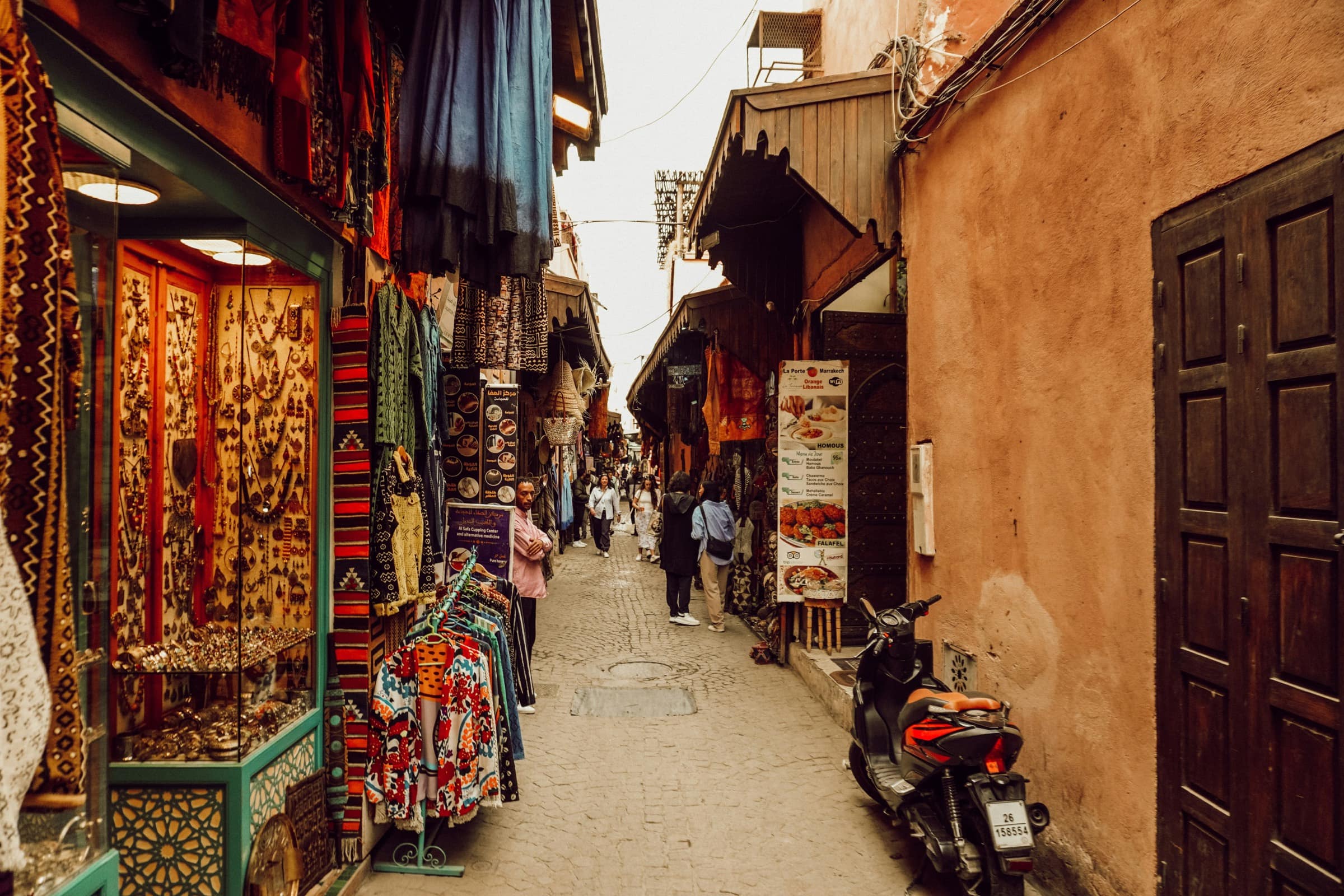
At the entrance to the dyers’ souk, wool dries in armfuls above the alley, saffron, indigo, madder. Push thirty metres and the smell changes: you have reached the coppersmiths, where copper rings under the hammer. That is the Marrakech souks - not a great catch-all bazaar, but a maze sorted by trade, a medieval-organisation heritage, where the smell often warns before the sign. Shopping the Marrakech souks starts with knowing where to go for what, what earns bringing back and how to haggle without losing your shirt.
The souks map: each trade, its alley
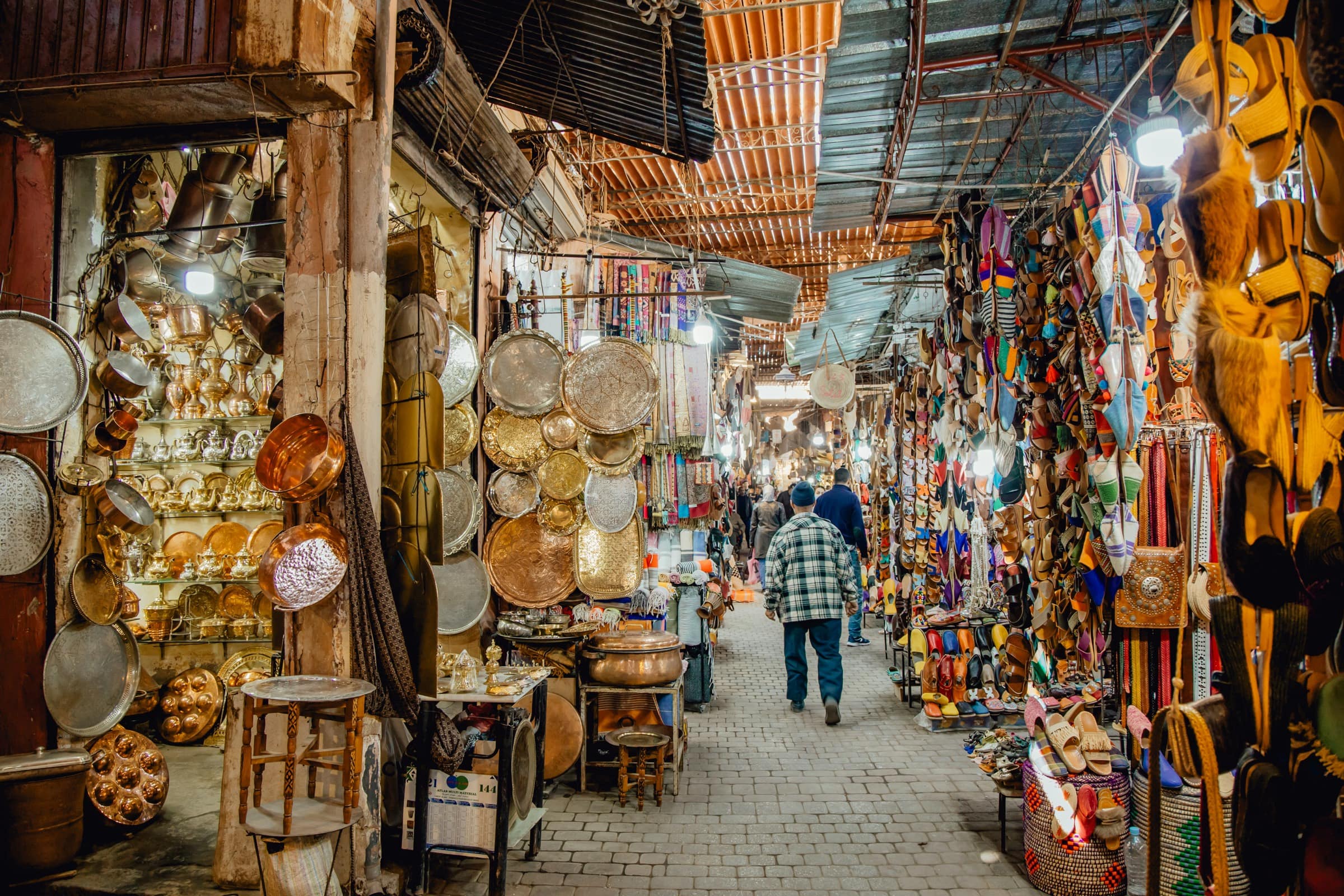
You enter by souk Semmarine, the covered artery running north from Jemaa el-Fna - the only one wide enough for two loaded donkeys to cross. From there, the alleys peel off by trade. Leather is worked at souk Cherratine, downstream from the Bab Debbagh tanneries where the hides still soak in the vats. Copper and brass shine at souk el-Attarine, iron is hammered at neighbouring souk Haddadine, which also lines up its lanterns.
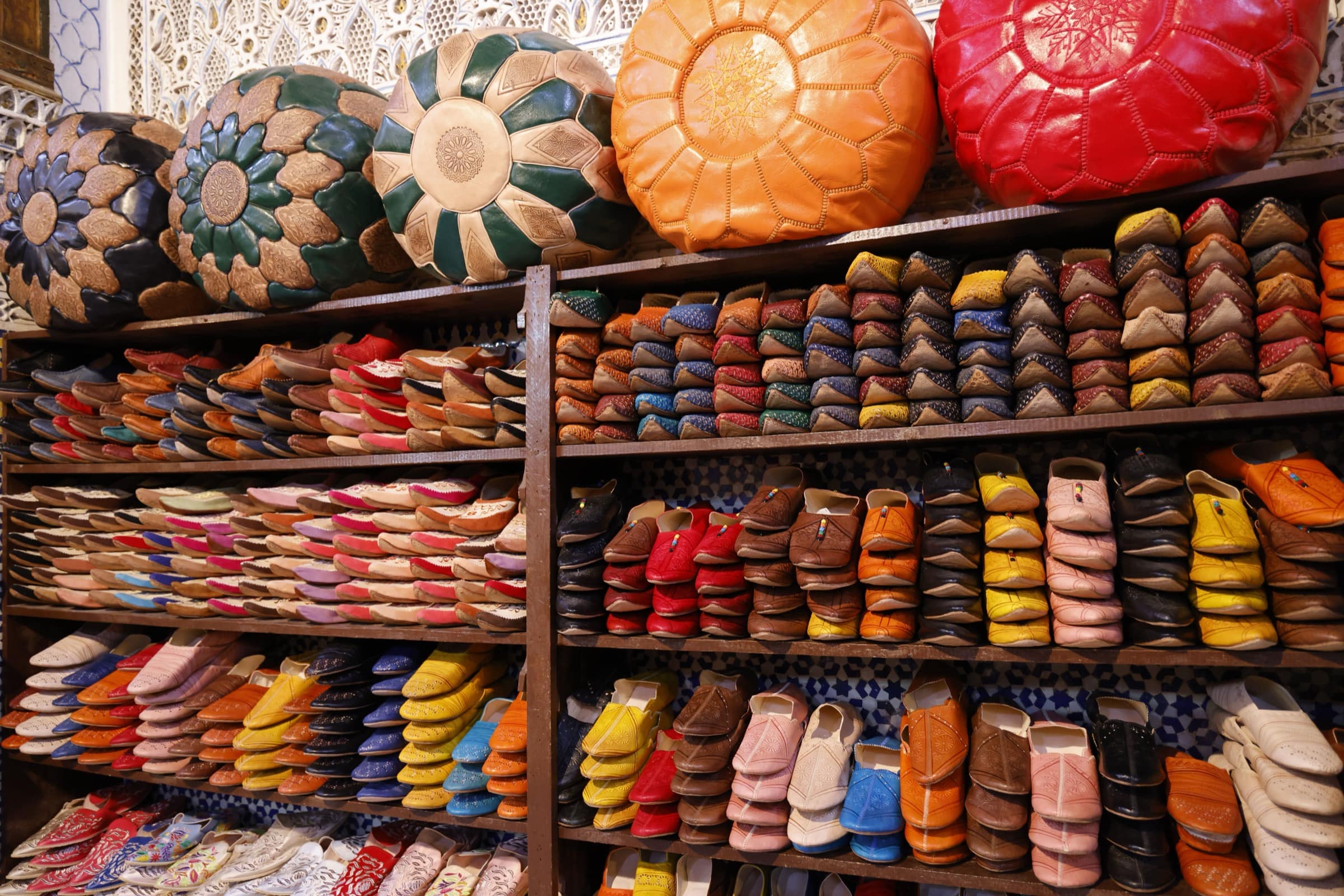
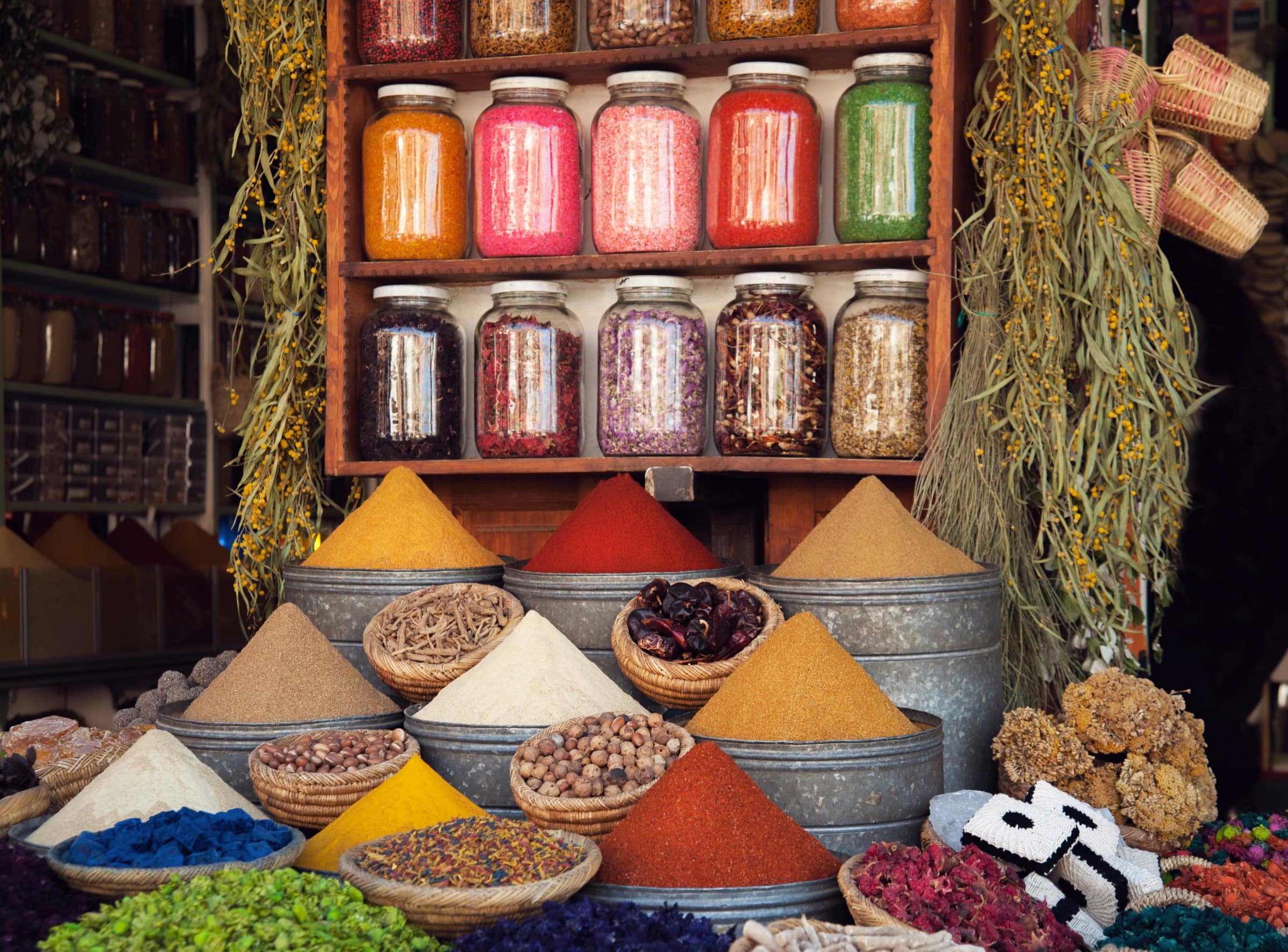
Further on, babouches stack up by the hundred at souk des babouches, dyed wools and silks dry at the dyers’ souk, and spices climb in pyramids on Place Rahba Kedima, where rugs are still called out by voice in the late afternoon. For the detail of each alley, see our souks overview.
What earns bringing back
The good keepsake is the one you use back home, not the one gathering dust. Our pick:
- Copper and brass come first: a teapot, an engraved tray, a tea service serve a whole life. Aim for hand-chiselled, heavier and more durable than the machine-pressed piece sold to passers-by.
- Babouches, but leather and never fabric: around 120 to 200 dirhams for a plain pair once negotiated, more for the embroidered models.
- Leather goods (bags, belts, poufs) are judged by touch: fold the leather, smell it, to catch the synthetic.
- Lanterns in pierced iron or brass, from 100-250 dirhams for a small aluminium one to a lot more for a fine piece.
- Spices and scents - ras el-hanout, cumin, tea, orange-flower water - to buy in small amounts and to taste if possible.
For cosmetics (argan oil, black soap, rose water), and, most of all, to avoid fakes, see our argan oil guide. Pottery and ceramics, finally, are superb but fragile in transit: pack them seriously.
Buying a rug in Marrakech
That is the most coveted purchase, and the most mined. A few markers.
Three big families come back. The Beni Ouarain, thick, cream wool with black diamonds, in high demand for decor and warm in winter. The kilim, flat-woven, geometric patterns. The boucherouite, motley, made of recycled fabric offcuts, each piece unique. Alongside them, the Azilal, colourful on a pale ground, and the Zanafi, plain in black and white.
To spot the real thing, turn the rug over: tight and even knots do not lie. Natural wool is soft and hard-wearing, a little irregular, and smells of wool without a chemical edge. An ‘old’ or ‘collection’ rug at a puffed price? New nine times out of ten. As for the price, it goes from single to triple across shops for the same 2 × 3 m Beni Ouarain: read up ahead, compare several sellers and remember the first quoted figure sits well above real. Cooperatives show more transparent prices, in exchange for a narrower choice. For shipping a big rug, ask for a written quote rather than a promise.
Haggling without getting caught out
Nearly everything is negotiated, and it is a game as much as a transaction. Look first, without showing your want - an eye that lights up puts the price up. Ask the rate, offer around half, then climb back in small steps, smile on. The tone counts more than the numbers. Most of all, learn to leave. ‘No thanks’ and three steps towards the exit are often enough to bring the price down - they call you back. Set a ceiling ahead of time and only buy what you actually wanted. Haggling ‘to see’ and then walking away is the one real foul.
Buying without haggling: fixed prices and outside the souk
Haggling is a game, but it wears down, and not everyone has the time or the wish to play it. Fallback spots exist at posted prices, no negotiation - handy for the traveller in a hurry, intimidated, or after guaranteed quality.
The fullest is Sidi Ghanem, the industrial estate in the north (ten minutes by taxi), turned into the district of contemporary Moroccan design: showrooms for decor, ceramics, fashion and concept stores, in air-conditioned shops. The anti-souk, also handy on heatwave days (closed on Sunday). You find established houses like Chabi Chic (tableware, ceramics) or LRNCE, the workshop of Laurence Leenaert (hand-painted textiles and ceramics), and more discreet ones like Côté Bougie or Héritage Berbère for scents. We dedicate a sheet to it: the Sidi Ghanem district.
In town, two addresses do the same job. 33 Rue Majorelle, the concept store opposite the Jardin Majorelle, gathers over a hundred Moroccan designers on two floors, at fixed prices, every day - the ‘quality-guaranteed’ stop to pair with the garden visit. And the Ensemble Artisanal, avenue Mohammed V five minutes from Jemaa el-Fna, is the state gallery where crafts sell at posted prices, no tout: leather, wood, pottery, copper and textile under one roof. You go there first, even without buying, to sharpen your eye on fair prices before heading into the souk.
For a rug without blind haggling, Soufiane Zarib (showroom near Dar el Bacha) is an advisory address more than a discount one: second-generation dealer, they steer you to the right piece - Beni Ouarain, vintage Berber, Tuareg mats - without souk pressure. The price is still open to discussion, but the relationship shifts.
One last date, more show than shopping: the rug auction at Rahba Kedima, every late afternoon around 4pm. Rugs pass from hand to hand, called out by voice in Arabic and Berber, sold at auction to the resellers. You come to watch this tradition, not to buy blindly - it is one of the finest moments of the souk.
The traps to know
- The spontaneous ‘guide’. Someone offers to show you ‘a cooperative’ or ‘the best workshop’: they take a commission added to your bill, no quality guarantee. Politely decline.
- Faked materials. Leather versus imitation, wool versus acrylic, ‘silver’ versus white metal: check yourself.
- Fake saffron. Sold cheap, it is nearly always safflower, the colour without the taste or the price. Real saffron is expensive. The bargain is the trap.
- Fake rarity. ‘Last piece’, ‘special price for you’, ‘my cousin closes shop tomorrow’: all sales levers. Take your time.
Our practical tips
Come before 10am or after 5pm: fewer crowds, better light, sellers more open to talk. Bring cash - many stalls refuse cards, and cash helps negotiate. Withdraw before entering the medina. Note a landmark (Semmarine, Jemaa el-Fna) and accept getting a little lost, that is the game. The best purchase, in the end, remains the one you chose, not the one sold to you.